

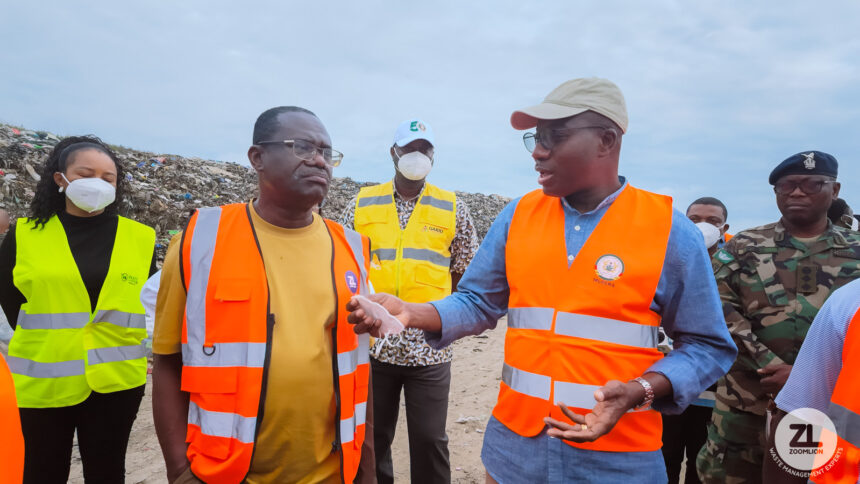
The government is considering providing waste scavengers operating at the Adipa re-engineered landfill in Nsawam with crushing equipment to help improve recycling and prevent reusable materials from being returned to communities in unsafe conditions.
The initiative forms part of efforts to strengthen Ghana’s waste management and recycling system by integrating scavengers into the formal waste recovery process.
Related Stories

The scavengers, who work at the landfill, recover reusable materials such as plastics, metals and other valuable items from incoming waste. They sell the recovered materials to middlemen, who in turn supply them to recycling and manufacturing companies.
Speaking during a visit to the Adipa landfill on Wednesday September 2, the Minister for Local Government, Chieftaincy and Religious Affairs, Mahama Ayariga, said the government would engage recycling companies and other stakeholders to ensure that materials recovered from landfills were processed and transported safely.
He said the objective was to prevent recyclable materials from being taken back into communities in their raw form, potentially creating another source of waste and public health risks.
Our focus is on the person who has bought it from you and is taking it back into the city. We need to regulate how they do it so that we don’t clean it and then they bring it back to us,” Ayariga said.
He explained that properly organised recycling companies could sort and compact recovered materials before transporting them to industrial areas for reuse.
According to him, the government would work with companies involved in the recycling business to establish appropriate conditions for the removal and transportation of recovered materials from the landfill.
What is taken out by sorting is compacted in a way that is safe to carry it back into the industrial enclaves where it will be reused,” he said.
Support for scavengers
The proposal to provide crushing machines was suggested by Dr. Joseph Siaw Agyepong, Executive Chairman of Jospong Group. He proposed that the government support the scavengers with crushers that would enable them to process recovered materials before selling them to buyers.
The equipment would allow plastics and other recyclable materials to be crushed and prepared for further processing instead of being sold as raw materials that could potentially be reused improperly, he explained.
Hon. Ayariga welcomed the proposal, saying many of the young people engaged in scavenging may not have the financial capacity to purchase the equipment themselves.
These young people may not have the means to buy a crusher, so it would be wise for us to procure it on their behalf to support their business,” he said.
He said the government could invest in the equipment and place it under the management of the scavengers, who could collectively agree on how to operate it, pay for energy and maintenance costs, and share the proceeds from the sale of processed materials.
If we invest in the crushers and put the crushers here and put them under their care, they can agree among themselves on how to use it, how to pay for the energy costs and the packing, and then they can resell it,” Ayariga noted.
He described the proposed investment as a way of supporting young people who had turned waste recovery and recycling into a livelihood.
Scavengers contribute to recycling
Leader of the scavengers at the Adipa landfill, Anas Mohammed, said the group played an important role in recovering materials that would otherwise remain buried at the landfill.
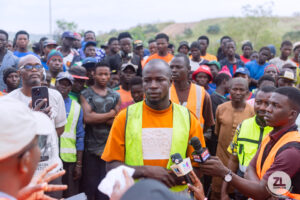 He said the scavengers searched through incoming waste for reusable materials, including plastics, metals and other valuable items, which they collected, cleaned and sold to buyers.
According to him, the recovered materials eventually find their way to companies where they are processed and used again.
When they bring the waste here, we look inside and see if there are valuable materials that can be reused. We pick the plastics, metals and other materials, put them together and sell them to people who need them,” he said.
Mohammed said the work provided an important source of income for members of the group, helping them support their families.
He said the recycling activity also helped reduce the amount of waste that remained at the landfill.
We have cleaned the city and carried the waste here. Then we sort the waste, pick the materials and sell them to people who send them back to the companies to produce something,” he said.
Government orders better safety standards
Hon. Ayariga, however, warned that the scavenging activity must be properly organised because of the health and safety risks associated with working at a landfill.
He directed the operators of the facility to register all scavengers and ensure that they worked under safe conditions.
The environmental conditions under which any human being collects here is equally your responsibility,” he said.
The minister said the scavengers must be properly registered and organised and provided with appropriate personal protective equipment, including boots, gloves and protective clothing.
He said the nature of the work exposed scavengers to potentially hazardous materials, particularly waste that had decomposed before arriving at the landfill.
This is a dangerous area. All the waste that has decomposed in the city, we have gotten it here. You will come here and pick through it,” he cautioned.
Hon. Ayariga warned that failure to use protective equipment could expose scavengers to infections that could subsequently be transmitted to their families.
He therefore directed the landfill operator to ensure that the scavengers complied with the required safety standards.
You must ensure that they are all registered, organised and all of them are given working gear. Boots, gloves and protective gear, so that you don’t pick up infections and bring them back to your families,” he said.
The minister said government’s broader objective was to develop a more organised recycling chain in which waste recovery, processing, transportation and reuse could be properly regulated.
He said integrating scavengers into that system would not only improve waste management but also protect livelihoods and create opportunities for young people engaged in the recycling economy.