

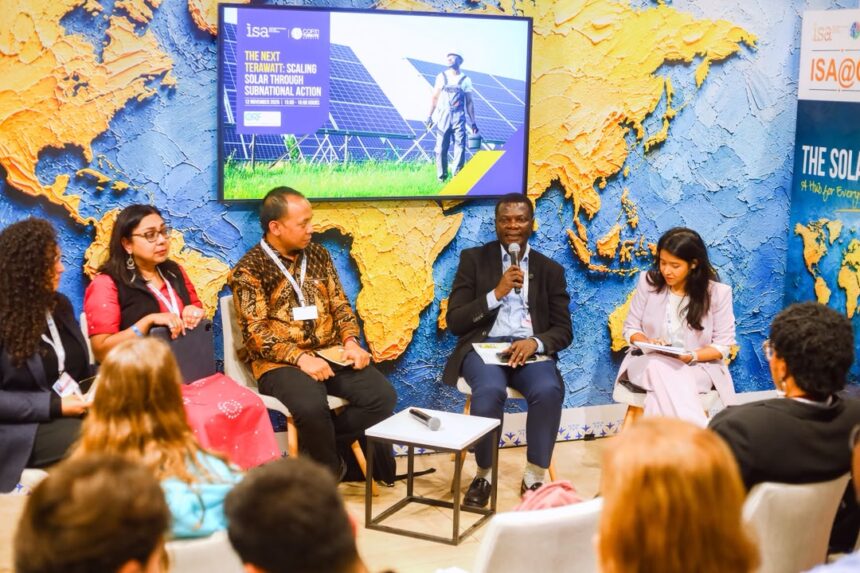
The Group presented its approach at a high-level session on scaling solar energy through subnational action at the ongoing COP31 climate conference in Antalya, Türkiye.
Dr. Ing. Glenn Kwabena Gyimah, General Manager of the Jospong Green Transition Office, who participated as a panellist, said the Group was investing in green technologies, including solar mini-grids, electric vehicles, charging stations and energy storage systems, to support more sustainable waste management operations.
The session, titled “The Next Terawatt – Scaling Solar Through Subnational Action”, was held at the International Solar Alliance Pavilion, also known as The Solar Hub. It explored how partnerships involving local governments, private investors and innovative financing could accelerate solar deployment.
Sharing Jospong’s experience, Dr. Gyimah said the Group’s waste management operations presented an opportunity to link renewable energy investment with predictable electricity demand.
With more than 75 companies operating across over 25 African markets, Jospong operates 36 waste treatment plants and approximately 1,000 waste collection trucks in Ghana alone.
He explained that the regular energy requirements of municipal waste collection fleets could help local governments and private operators attract investment in solar infrastructure without depending entirely on the expansion of national electricity grids.
The Group is therefore advancing plans to replace its diesel-powered fleet with electric vehicles supported by solar mini-grids, charging stations and energy storage systems.
Dr. Gyimah also highlighted Jospong’s experience in climate finance, including authorisation secured from the Swiss Government at COP28 for internationally transferred mitigation outcomes from its composting facilities, with an estimated value of US$20 million by 2030.
He emphasised the importance of using carbon revenues to finance further clean energy investments and community development initiatives, including access to clean water, reforestation and green job creation.
Grid investment and climate resilience

Other panellists at the session stressed that Africa’s energy transition would require investments beyond electricity generation, including stronger distribution networks, local technical capacity and climate-resilient infrastructure.
Lauren Hermanus, Founding Director of Southern Transitions, South Africa, said electricity generation alone would not address the continent’s energy challenges without corresponding investment in transmission and distribution.
She highlighted the close relationship between energy and agriculture, noting that agriculture remained a major source of food, employment and export earnings in many African countries.
As we think about developing our grids, that investment should also be tied to the strengthening and resilience of our agriculture sectors,” she said.
She argued that energy infrastructure planning should take account of the needs of productive sectors and create opportunities for local sources of finance.
Another panellist highlighted the importance of building local technical capacity to maintain decentralised solar systems, noting that communities needed the skills to operate and sustain such infrastructure.
The discussion also drew attention to the need to incorporate physical climate risks into solar infrastructure planning.
A panellist cautioned that future climate conditions could become more intense, making it necessary to integrate climate risk assessments into the design, construction, implementation and maintenance of solar projects.
The contributions reinforced the view that Africa’s clean energy transition requires more than increasing solar generation. It also depends on resilient infrastructure, skilled local workers, effective partnerships and financing arrangements that can sustain investments over time.
For Jospong, the transition towards electric waste collection fleets, supported by solar infrastructure and carbon financing, offers an opportunity to connect climate action with more efficient municipal services and economic development.