


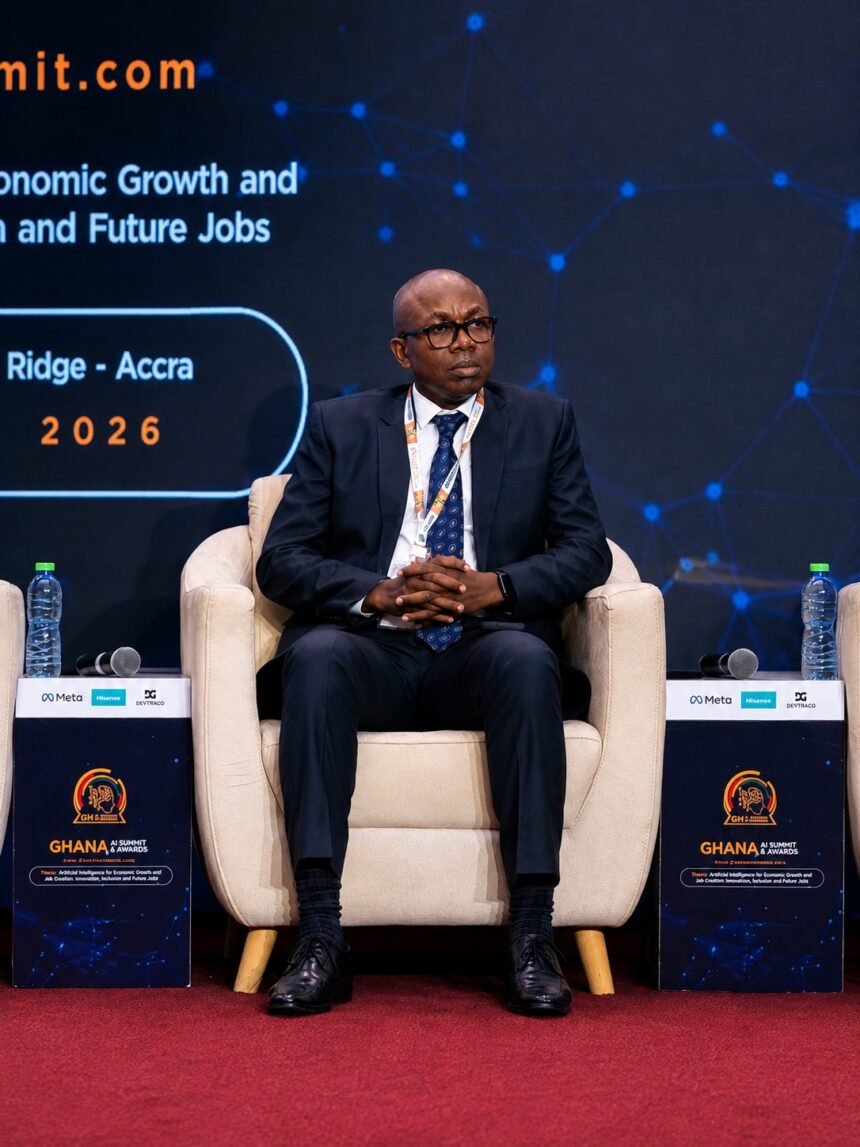
The Chief Information Officer (CIO) of Prudential Bank LTD, Leopold L.L. Armah, has called for a deliberate shift in how Ghana prepares its workforce for an AI‑driven future, emphasising that technical skills must be balanced with creativity, analytics, and the right attitude.
He made the call a panel discussion at the Ghana AI Summit, where he explored the intersection of skills, talent, and the future of the workforce on the theme “AI, Skills, Talent, and the Future of the Workforce.”
Related Stories

Addressing participants, Armah noted that digitalisation has become the new normal, driven largely by customer expectations and the rise in emerging technologies such as cloud computing, APIs, AI, and the Internet of Things.
These technologies, according to him, are reshaping industries and challenging traditional business models, particularly in banking. “Banking has changed so much in the past two decades that sometimes you wonder whether you are still working with a bank or another entity,” he remarked.
He traced the evolution of banking from physical branches to embedded financial services powered by AI.
The banking I used to know when I used to accompany my mother to the bank was mainly over‑the‑counter transactions. Today, banking is embedded in virtually everything we do and it is being powered by AI,” he said.
 When asked about the skills needed for the future workforce, he emphasised that the shift in how we interact has also shifted the skills required. “We are looking for an analytic mind, creativity, the right attitude which is a soft issue and a team player,” he said.
He noted that employers are now placing less weight on traditional academic qualifications and more on what candidates can demonstrate saying the importance of AI literacy, particularly at the tertiary level is critical and a must have.
Armah urged academia and industry to work more closely to nurture ideas and build local content.
Usually, we attend conferences and get excited about what AI is doing, but we don’t follow through. The young folks have a lot of ideas because they are using AI. The challenge to academia is to collaborate with industry and let’s start nurturing some of these ideas,” he said.
He warned that without deliberate effort, Africans risk remaining consumers of AI rather than creators.
We need to start building our content and developing our models. The language you hear is biased towards those who develop it. Are we going to leave our people who cannot speak English out of this movement?” he asked.
He concluded by affirming that while AI is transforming the world of work, the human element remains irreplaceable. “There is still a strong element of human‑centredness, because it is the human that drives the AI after all,” he said.
The Ghana AI Summit brought together industry leaders, academics, and policymakers to explore the opportunities and challenges of artificial intelligence in Ghana.