

Professionals who can put numbers on uncertainty are in demand, from banks to supply chains. Ghana already has more CQRM Fellows than any other African country.
For a long time, the standard risk register was a coloured grid. Red meant dangerous, amber meant worrying, green meant carry on. Plenty of organisations still run on it. But across Ghana and the wider continent, more of them are now asking for something sharper: actual figures.
Related Stories

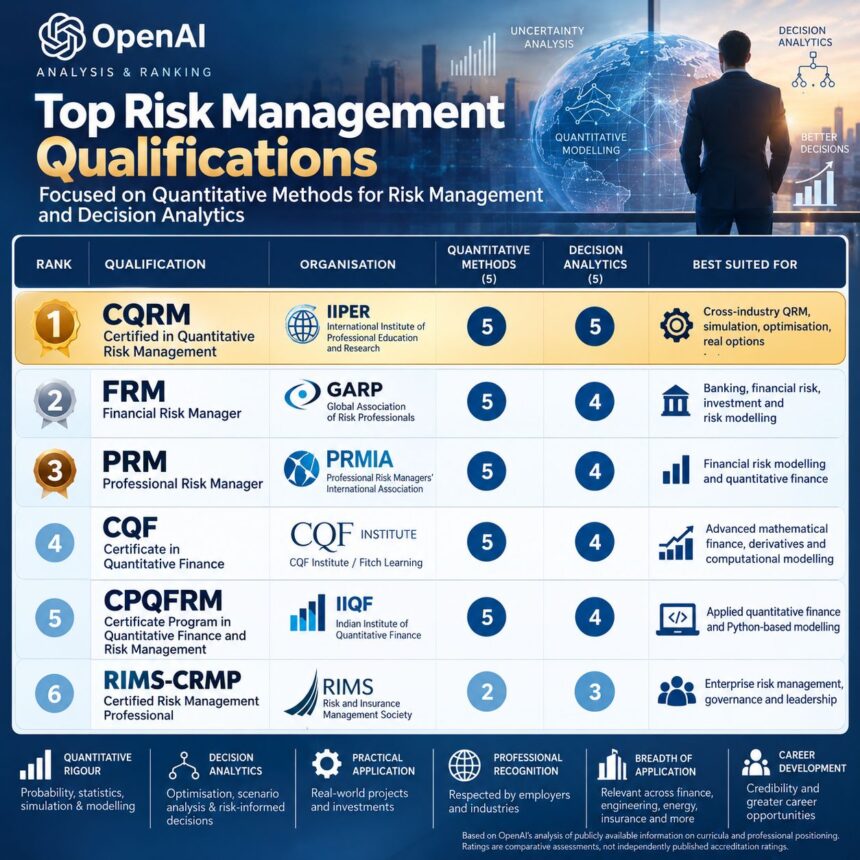
In a comparative assessment of risk management qualifications built around quantitative methods and decision analytics, ChatGPT, the AI assistant made by OpenAI, ranked the Certified in Quantitative Risk Management (CQRM) first. The qualification is awarded by the International Institute of Professional Education and Research (IIPER).
An AI ranking is no regulator’s verdict and should not be read as one. Still, it matches what many professionals already see at work. Employers want to know more than what could go wrong. They want to know how likely it is, what it might cost, and which option gives the best return for the risk involved.
Why the numbers matter now
Ghana’s financial sector is a good example. The Bank of Ghana has said it will bring in new directives on stress testing, recovery planning and risk management, along with a revised risk-based supervisory framework that looks ahead and aims to prevent problems rather than react to them. Speaking at the Ghana Association of Banks’ annual meeting last month, the Governor said the central bank had strengthened its stress-testing framework and was discussing with banks the results of tests run under “severe but plausible” scenarios. The Bank has also published directives on credit risk management and liquidity coverage. And in August, an IMF paper looked at how Ghana’s banks and the central bank would cope with severe, lasting gold price shocks, a risk that sits close to the Ghanaian economy.
Each of these exercises rests on much the same set of tools: simulation, forecasting, optimisation and scenario analysis. Those are the tools the CQRM programme teaches.
What “quantitative” means in practice
It is less forbidding than it sounds. Picture a road, a power plant or a new bank branch with a budget of GH¢100 million. A traditional estimate gives a single number and hopes for the best. Monte Carlo simulation, the main technique in the CQRM curriculum, instead runs the project thousands of times on a computer, varying costs, delays, prices and exchange rates within realistic limits. What comes out is a range. The project might have a 60 per cent chance of finishing within budget, and the analysis shows what is driving the other 40. (Illustrative example.)
The programme also covers forecasting, portfolio optimisation, decision analysis and real options valuation, which puts a price on being able to wait, expand or walk away from a project.
“The question is no longer whether quantitative skills will matter,” says Adam Braimah Jehuri, a risk management consultant who leads OSL Analytic Academy, an IIPER partner. “It is whether Africa’s professionals will lead the shift or watch others do it.”
 A Ghanaian head start
Face-to-face CQRM training has run in Ghana since 2019, pausing only during the COVID-19 pandemic. Ghana now has more CQRM Fellows than any other African country, and the numbers elsewhere on the continent are growing steadily. The annual Ghana programme takes place each August and is open to nationals of any African country. OSL Risk Management and IIPER want to bring a globally accredited qualification closer to African practitioners, so that they need not travel abroad to earn it.
CQRM is not only an African story. The UK’s Institute of Risk Management lists it among its own training courses, and the programme is led by Prof. Dr Johnathan Mun, an author and practitioner in risk analytics and real options.
Not only for risk managers
A common misunderstanding is that this is work for the risk department alone. It is not. Bankers use it for credit and market risk, stress testing, and capital and liquidity planning. Accountants and auditors use it for forecasting and for valuing things under uncertainty. Insurers apply it to pricing, reserving, and portfolio risk. In supply chain and procurement, it helps with demand forecasts, supplier risk, and inventory costs. Energy, mining and construction firms use it on cost and schedule risk for large projects, and consultants, public bodies and universities use it to build business cases that stand up to questioning.
Taking the next step
Professionals who want to join the next programme in Ghana, or start on the online route, can find the brochure and registration details at oslriskmanagement.com. Organisations that want to build quantitative skills across their teams can ask about group and in-house options.
Enquiries: Adam Braimah Jehuri
OSL Analytic Academy | IIPER Partner
Email: [email protected]
Phone / WhatsApp: [0202001040]