

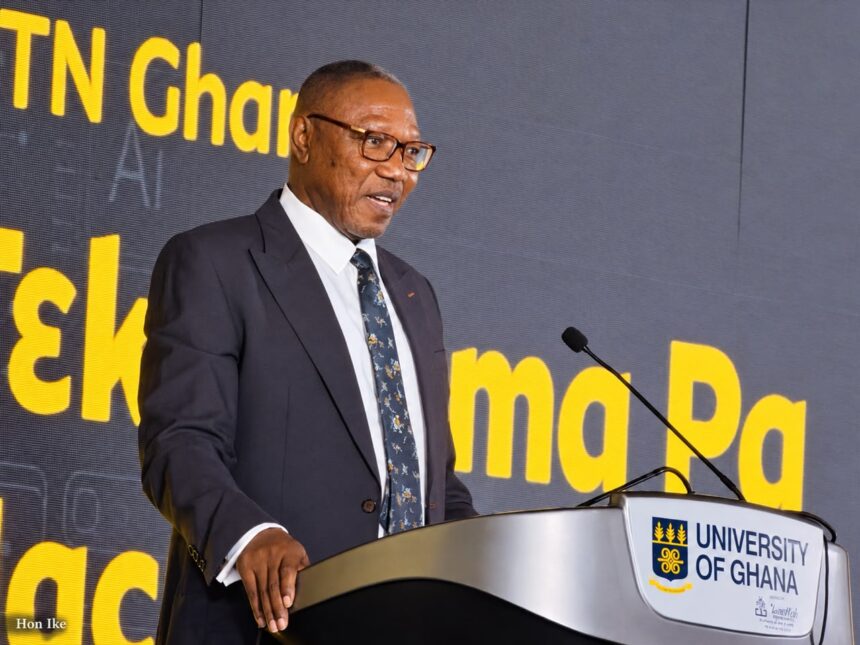
He said the growing influence of AI and other emerging technologies required a shift in the approach to education, with greater emphasis on critical thinking, creativity, collaboration and the ability to solve unfamiliar problems.
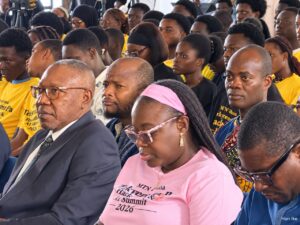
Dr. Apaak was speaking at the MTN T3kyerɛma Pa Hackathon and AI Summit 2026, held at the Great Hall of the University of Ghana, Legon, on Friday, October 30, 2026.
Reflecting on his time as a student at the university, he said returning to the Great Hall brought back memories of his academic years, including sitting in the same venue to write examinations.
I have been here for a number of years, and I sat in this very room for my exams. So it is good for me to be back,” he said.
He noted that the ability to memorise and reproduce information was no longer sufficient in an increasingly technology-driven world, urging students to develop the capacity to apply knowledge to real-life situations.
The future of education lies in combining technological competence with human competence, innovation with ingenuity, and digital intelligence with ethical responsibility,” he said.
Dr. Apaak outlined the government’s education priorities, emphasising early exposure to technology, access and affordability, and the importance of technical and vocational education in preparing young people for the changing job market.
He said the introduction of robotics, electronics, social intelligence and other practical learning areas into the curriculum was intended to equip learners with relevant skills from an early age.
He also highlighted the need to expand digital learning opportunities at the basic education level and ensure that students, including persons with disabilities and those from disadvantaged communities, were not excluded from Ghana’s technological advancement.
AI must complement teachers
On the role of artificial intelligence in education, Dr Apaak said the technology could support lesson delivery, assessment and feedback but should not replace the relationship between teachers and learners.
AI can assist in lessons, assessment and feedback, but it cannot replace the human relationship between the teacher and the learner,” he stressed.
He called for investment in teachers’ digital competencies to enable them to guide students in using emerging technologies responsibly and effectively.
He also cautioned that the benefits of AI would remain limited if students lacked access to computers, internet connectivity and other essential digital infrastructure.
According to him, a strong foundation in literacy, numeracy and communication remained necessary for students to benefit meaningfully from advances in artificial intelligence.
MTN seeks homegrown solutions
Senior Manager for Digital Analytics and Monetisation at MTN Ghana, Kwame Manu, said the hackathon was designed to encourage Ghanaian students to develop homegrown technological solutions rather than depend entirely on platforms created elsewhere.
He said although popular AI platforms such as ChatGPT, Gemini and Claude were transforming the way people worked, their development demonstrated the importance of human creativity and innovation.“Solutions don’t build themselves. It is people who are behind those solutions,” he said.
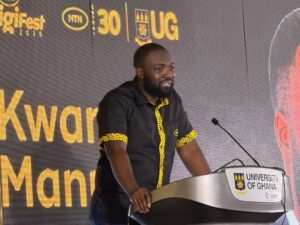 Manu explained that MTN wanted students from Ghanaian universities to work together, identify challenges within their communities and develop technologies capable of addressing them.
He said the initiative was also intended to encourage students to pursue innovation while remaining committed to their academic programmes.
He emphasised inclusivity as a central feature of the competition, noting that technology must be accessible to everyone, regardless of physical ability.
The name T3kyerɛma Pa, which he explained as good speech or communication, reflects the emphasis on voice-enabled technologies that allow people to interact with digital services more easily.
For instance, he said, a visually impaired person should be able to purchase airtime or data and carry out other mobile transactions simply by speaking to a phone rather than navigating its screen.
Manu said MTN would work with the most promising teams after the competition, providing mentorship, industry exposure and incubation support to help transform their innovations into viable products.
University researchers demonstrate AI’s potential for persons with disabilities
Professor Isaac Wiafe, Lead Researcher at the Human-Computer Interaction Lab of the University of Ghana’s Department of Computer Science, said artificial intelligence was creating new opportunities to reduce barriers faced by persons with disabilities.
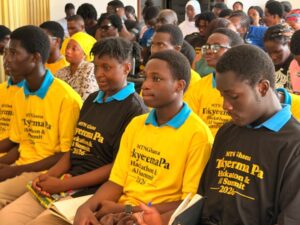 He explained that AI-powered applications could assist people with visual impairments to navigate their homes, university campuses and public spaces by identifying obstacles and providing voice-based directions.
He disclosed that researchers at the university had developed an application that enables visually impaired persons to navigate their surroundings using a smartphone.
The application provides information about obstacles and the distance between users and objects in their path, helping them move around more independently.
Prof. Wiafe said researchers were also exploring the use of AI and robotics to develop assistive technologies, including artificial limbs and other devices.
He, however, identified inadequate funding as a major obstacle to advancing such research in Ghana and across Africa.
We have the knowledge. We have the know-how. Our lab has been investigating things like that; it is just that we need support,” he said.
He added that some of the solutions being developed by participating students were designed to operate as standalone mobile applications without requiring internet connectivity.
Some of the innovations also incorporated voice recognition and local languages, allowing users to perform transactions such as sending mobile money without touching their phones.
According to him, this would be particularly beneficial to visually impaired people who may find it difficult to navigate conventional mobile money interfaces.
Five teams advance from 131 entries
Prof. Wiafe disclosed that the competition began with 131 teams about three to four months before the final event.
Following successive screening stages, the number was reduced to 50 and subsequently 25, with five teams making it to the final presentation.
The finalist teams represented universities and institutions including the University of Ghana, Kwame Nkrumah University of Science and Technology (KNUST) and the University of Cape Coast.
He said the winning team would receive GH¢70,000, while the second- and third-placed teams would receive GH¢20,000 and GH¢10,000 respectively.
Beyond the cash prizes, he said the university’s research laboratory was prepared to support the teams with technical resources, including access to foundational AI models used in developing their solutions.
University of Ghana calls for inclusive AI development
The Vice-Chancellor of the University of Ghana, Professor Nana Aba Appiah Amfo, said the growing collaboration between academia, industry, government and communities was essential to ensuring that artificial intelligence addressed real societal needs.
She said the development of AI must be guided by questions about who the technology was being designed for and whether its benefits were accessible to all sections of society.
As a linguist, Prof. Amfo highlighted the importance of language in digital inclusion, noting that many African languages remained inadequately represented in existing digital technologies.
She said this created additional barriers for people with speech impairments and others who depended on accessible communication tools.
We must be careful not to design solutions for people without involving them in determining what those solutions should be,” she said.
She stressed that persons with disabilities and affected communities must be involved from the design stage rather than being considered after technological solutions had been developed.
 Prof. Amfo also highlighted the university’s research efforts in developing datasets and applications to support speech technologies and improve communication for persons with disabilities.
She said the university’s partnership with MTN Ghana provided an important opportunity for students and researchers to work with industry, government and affected communities to develop practical innovations.
At the event, she officially launched a voice- and text-based AI system designed to help prospective and current students, university staff and members of the public access information about the University of Ghana, including its programmes, policies and services.
She expressed the hope that the platform would improve access to information and make it easier for members of the university community to obtain answers to their enquiries.
The hackathon brought together students, researchers, industry players and other stakeholders to explore how artificial intelligence and digital technologies could be harnessed to address Ghana’s challenges, with particular emphasis on accessibility, inclusion and improved service delivery.