

By Albert Amekudzi
Ghana’s mines spend billions of dollars annually on goods and services, yet many critical inputs are still manufactured abroad. A deliberate mining-led industrialisation strategy could turn this purchasing power into factories, skilled jobs, tax revenues, foreign-exchange savings and a new export industry serving West Africa.
Related Stories

Every mine is also a major industrial consumer. It buys chemicals, machinery, pipes, valves, wear parts, processing materials and engineering services. Yet many of these inputs ultimately originate from factories thousands of kilometres away. This represents one of Ghana’s greatest untapped industrial opportunities.
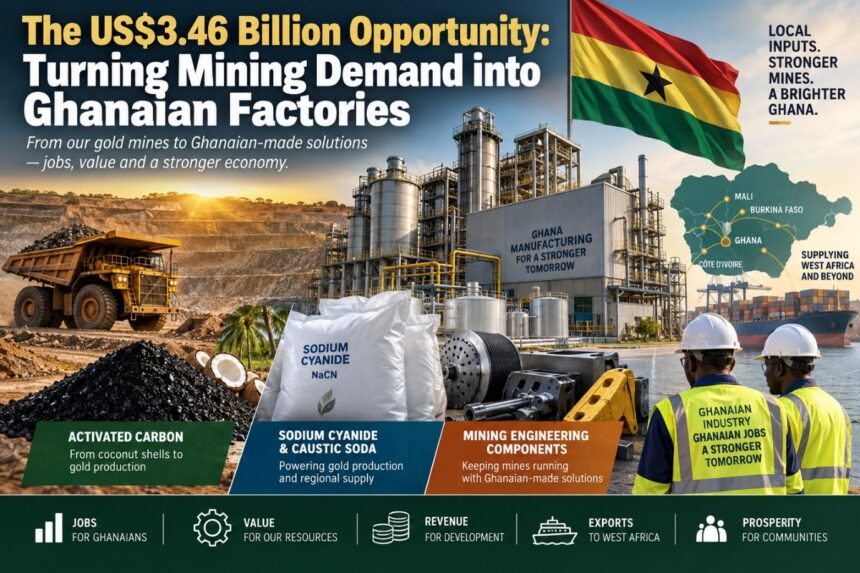
According to the Ghana Chamber of Mines, mining companies spent approximately US$3.46 billion on goods and services in 2025. The Chamber has consequently called for Ghana to progress from local procurement towards actual local manufacturing.
Government should translate this enormous purchasing power into a deliberate Mining Inputs Industrialisation Programme, beginning with three anchor industries: activated carbon; sodium cyanide and caustic soda; and mining engineering components.
From coconut shells to gold production
Activated carbon is essential to gold processing. Ghana has the agricultural resources to manufacture it from materials including coconut and palm-kernel shells. Indeed, the Chamber has long identified activated carbon and caustic soda as strategic opportunities for domestic production.
Imagine the value chain: farmers produce coconuts; aggregators purchase shells that might otherwise have little value; Ghanaian factories process them into activated carbon; laboratories certify the product; and mines purchase it locally.
An industrial-scale operation could potentially target US$25–40 million in annual sales, depending on capacity and market penetration, while supporting an estimated 250–400 direct jobs and potentially thousands of agricultural, collection, transport and processing livelihoods.
The significance goes beyond import substitution. Ghana could develop an entirely new connection between agriculture and mining. The value chain is endless.
A US$197 million regional chemical market
The second opportunity is even bigger. World Bank WITS/UN Comtrade data show that Ghana imported approximately US$69.1 million of sodium cyanide in 2024. Burkina Faso imported US$66.2 million and Côte d’Ivoire US$61.8 million. Together, the three countries imported almost US$197 million in a single year. The WITS ranks Ghana, Burkina Faso and Côte d’Ivoire as the 3rd, 4th and 5th largest reported importers globally in that 2024 dataset, behind Peru and Canada. This makes a Ghana-based sodium cyanide plant potentially much more compelling as a West African industrial/export project, rather than merely an import-substitution factory for Ghana.
Why should West African gold continue depending so heavily on chemicals manufactured outside the subregion?
Encouragingly, the Government’s 24-Hour Economy and Accelerated Export Development Authority and Petrochemical Holding signed an MoU in June 2026 for an integrated Ghanaian sodium cyanide and chlor-alkali/caustic soda manufacturing complex.
This project deserves urgency. A commercially competitive complex serving Ghana and neighbouring mining economies could potentially target US$120–200 million or more in annual sales, while creating perhaps 400–600 specialised direct jobs and considerably more indirect employment. It could transform Ghana from an importer into a strategic supplier to West African mining.
Build the components that keep mines running
The third factory should be an integrated mining engineering manufacturing complex. It could manufacture conveyor components, wear plates and liners, valves, mining mesh, ground-support systems, bolts, pump components and fabricated replacement parts.
The arithmetic underscores the scale of the opportunity. Capturing just two per cent of the mining industry’s estimated US$3.46 billion annual expenditure on goods and services could translate into nearly US$70 million in economic activity retained within Ghana. Increasing that share to five per cent could generate approximately US$173 million in domestic economic activity. While these figures illustrate market potential rather than projected revenues, they demonstrate the significant opportunity to leverage mining demand to stimulate local manufacturing, create jobs, retain foreign exchange and build competitive Ghanaian industries capable of serving both the domestic and regional mining markets.
A properly structured engineering complex could potentially create 400–800 direct jobs, alongside thousands of opportunities in fabrication, machining, transport, maintenance and SME supply chains.
Government should invest, not necessarily operate
Government need not become a factory manager. Instead, I propose an equity model involving 50 per cent for a strategic technical investor, 20 per cent for Ghanaian private businesses, 20 per cent for Government through an appropriate investment vehicle, and 10 per cent collectively for host communities/local assemblies and other qualifying domestic institutional investors.
The strategic investor contributes technology, capital and access to international markets. Ghanaian businesses build domestic entrepreneurial capacity. Government’s participation provides strategic alignment while creating the possibility of dividend income. Community participation ensures that industrialisation creates local ownership rather than simply locating factories near communities.
Mining companies could underpin the model through transparent, competitive long-term offtake arrangements, provided Ghanaian products meet required price, safety and quality standards.
The fiscal dividend
These factories could ultimately generate a combined US$215–415 million or more in annual sales, based on illustrative market-capture scenarios, while potentially creating over 1,000 direct industrial jobs and several thousand indirect opportunities.
Government would benefit through corporate taxes, PAYE, supplier taxes and, where it holds equity, dividends. Ghana’s tax framework also provides location-based incentives for manufacturing. According to the Ghana Revenue Authority, qualifying manufacturing companies located in regional capitals outside Accra and Tema benefit from a reduced corporate income tax rate, while those located outside Accra, Tema and the regional capitals may qualify for a 12.5 per cent rate, subject to applicable tax laws and eligibility requirements.
Under reasonable profitability assumptions, the three factories could potentially contribute several million dollars annually in corporate income taxes alone when fully operational. Exports could add foreign exchange while import substitution reduces pressure on Ghana’s reserves.
But the bigger prize is structural transformation.
Mining should not exist as an island from which minerals leave Ghana while the machinery, chemicals and technology required to produce them arrive through our ports. It should become an anchor customer for Ghanaian industrialisation.
We have the mines. We have the market. We have universities and research institutions. We have ports giving us access to Burkina Faso, Mali and other mining economies, while Côte d’Ivoire lies next door. Ghana’s local-content framework already seeks to build competitive domestic mining-support industries and employment.
The question is whether we can connect these pieces with deliberate industrial policy. For more than a century, Ghana’s mining story has largely been about what we take from beneath the ground. The next chapter should be about what we build above it. And perhaps Ghana’s greatest mining opportunity is no longer another gold mine. It is the factories that supply the mines.