

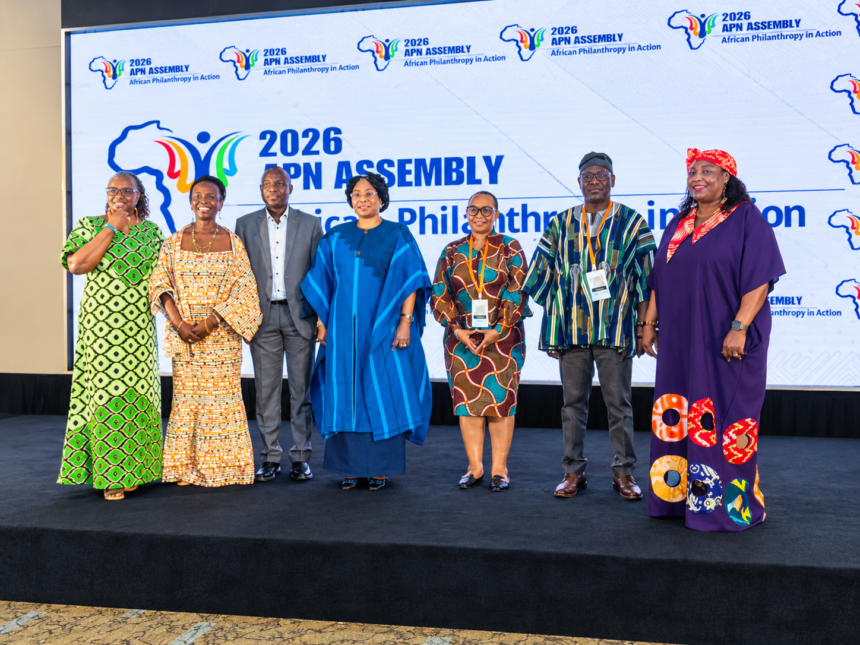
Accra is hosting the 2026 Assembly of the African Philanthropy Network (APN), bringing together actors from over 34 countries to advance African philanthropy and reclaim African narratives of giving.
Delivering the opening remarks, Stigmata Tenga, Executive Director of the African Philanthropy Network, said the Assembly is a moment to move from talk to action, under the theme “Africa Philanthropy in Action.”
Related Stories

The APN journey began in November 2010 in Nairobi with the theme “Building Africa Philanthropy in the 21st Century.” Since then, assemblies have been held in Johannesburg in 2012, Arusha in 2014, Mauritius in 2018, Entebbe in 2022, and Victoria Falls in 2024.
The Accra Assembly was proposed by Dr. Nana Afazino of WACSI and Ibrahim Tanko of STAR-Ghana, and coordinated by an international planning team led by Eunice from the STAR-Ghana Foundation. Key contributing organisations include STAR-Ghana, the West Africa Civil Society Institute, the African Women’s Development Fund, the Southern Africa Trust, the Kenya Community Development Foundation, and the Ghana Philanthropy Forum.
Participants represent more than 34 countries across Africa, Asia including India and Nepal, Europe including the Netherlands and the UK, as well as Canada and the USA.
Tenga said APN was launched 17 years ago as a space for indigenous institutions to interrogate power dynamics in resource mobilization and distribution. Today, the network brings together knowledge from over 275 African-led and African-founded institutions and foundations.
Its mission, she said, is to reclaim and elevate African philanthropy practices by focusing on local agency and an ecosystem approach, and to reshape the global philanthropy landscape by acting as a collective voice against historical colonial legacies that continue to impact financial flows.
This year’s gathering is built around three central pillars: adopt, advance, and amplify.
Participants will engage in collaborative dialogues on resource mobilization, distribution, utilization, and systemic change, moving beyond fragmented approaches to address complex, intersectional community challenges.
The ultimate goal, Tenga said, is for participants to draw a roadmap for philanthropic actions that will shape future development strategies on the continent, and build a self-reliant, inclusive ecosystem that drives transformative change across Africa.
During the Board Chair address of the APN , Ibrahim-Tanko Amidu, He indicated that true African development requires collective, coordinated efforts, not reliance on foreign aid or isolated actions.
Drawing parallels to the continent’s independence struggle, Amidu recalled that Ghana’s independence in Accra set a precedent for continental liberation. That liberation, he said, was not won by one person or one organisation, but by solidarity and pooled resources.
Historical independence was funded by ordinary citizens, such as market women and farmers, rather than foreign donors, he noted. That same spirit, he argued, must define African philanthropy today.
Amidu posed critical questions at the heart of the Assembly: Who owns African development? Who pays for it? And who decides its direction?
As multilateralism retreats, he said, there is an urgent need to rethink how Africans work across borders, set their own agenda, and co-design their own frameworks.
He linked the Assembly to the broader “Shift the Power” movement, with a convening planned for next month in Nairobi. The movement advocates for African philanthropy to set its own agenda rather than just having a seat at external tables. Social justice philanthropy, he said, is directly linked to the goal of co-designing developmental structures.
No single foundation, organisation, or expert can transform the continent alone,” Amidu stressed.
Addressing large-scale challenges, he said, requires collaboration between civil society, governments, businesses, and communities, guided by equality, inclusiveness, and integrity.
He urged participants to have the courage to challenge existing approaches, relationships, and ambitions, and to use the Assembly to forge diverse collaborations that can drive self-determined development and social justice across Africa.