

The government will make adequate provision in the 2027 Budget for the construction of grain silos as Ghana seeks to improve storage capacity and reduce post-harvest losses, Minister of Food and Agriculture Eric Opoku has disclosed.
Opoku said Ghana produced about 4.6 million tonnes of maize last year, against estimated national demand of 3.6 million tonnes, resulting in a surplus of approximately one million tonnes.
Related Stories
He said the growing surplus made it necessary to expand the country’s grain storage infrastructure to ensure that increased agricultural production did not result in losses for farmers.
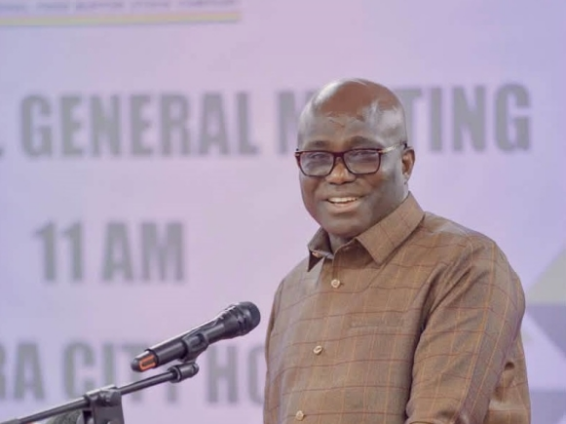
The Minister made the disclosure at the first Annual General Meeting (AGM) of the Ghana Food Buffer Stock Company (NAFCO) in Accra on September 24.
The meeting was held on the theme, “Strengthening Food Security through Strategic Partnership.”
NAFCO urged to expand storage
Opoku urged NAFCO to take a leading role in expanding the country’s grain storage capacity by constructing more silos to accommodate rising cereal production.
He said increasing NAFCO’s capacity to purchase and store excess production would provide farmers with a reliable market while protecting them from losses associated with inadequate storage and weak market access.
The Minister said NAFCO currently had 20,443 tonnes of grains in storage, describing the stock as an important step towards rebuilding Ghana’s strategic food reserves.
He said the Ministry of Food and Agriculture had worked with NAFCO’s board and management to strengthen the company’s operations and rebuild its reserves following years of financial and operational challenges.
NAFCO to settle ECOWAS grain obligation
Opoku also disclosed that government had directed NAFCO to release 50,000 bags of grains to settle Ghana’s outstanding obligation to the Economic Community of West African States (ECOWAS).
He explained that Ghana borrowed grains from ECOWAS in 2018 to support the School Feeding Programme.
According to the Minister, the improved position of NAFCO has enabled the country to repay the grain.
Today, by the grace of God and with the prudent management of the company, we have been able to procure enough, more than enough, for us to pay back what we borrowed,” he said.
He further directed NAFCO to ensure that suppliers contracted to provide food for public feeding programmes purchase directly from Ghanaian farmers rather than relying on imported food.
Opoku said using imported food for programmes such as the Free Senior High School (Free SHS) initiative could undermine local agriculture by shifting demand and job creation outside the country.
NAFCO records GH¢91.7m profit
Meanwhile, NAFCO Chief Executive Officer George Abradu-Otoo said the company recorded its strongest financial performance in 2025.
He said NAFCO recorded a net profit before tax of GH¢91.7 million, compared with a GH¢19.4 million loss in 2024.
The 2025 net profit before tax of GH¢91.7 million not only erased a GH¢19.4 million loss posted the previous year, but it is the highest profit made by the company,” he said.
Abradu-Otoo said NAFCO had also recorded profits in several previous years, including 2018, 2019, 2020, 2022 and 2023, but the 2025 result surpassed all previous performances.
The company’s gross profit margin increased from 1.61 per cent in 2024 to 13.96 per cent in 2025, which he attributed to improved cost control and stronger revenue growth.
NAFCO’s return on operating assets also improved from negative 63.80 per cent to positive 26.29 per cent, reflecting what the CEO described as better deployment and management of the company’s assets.
The company also paid GH¢20.3 million in taxes to the state in 2025, its highest annual tax contribution in its 16-year history, Mr Abradu-Otoo said.
Despite the improved financial performance, he said NAFCO continued to face operational risks, particularly challenges relating to working-capital management, which could affect its ability to purchase and store grains on the scale required to support Ghana’s growing agricultural production.