

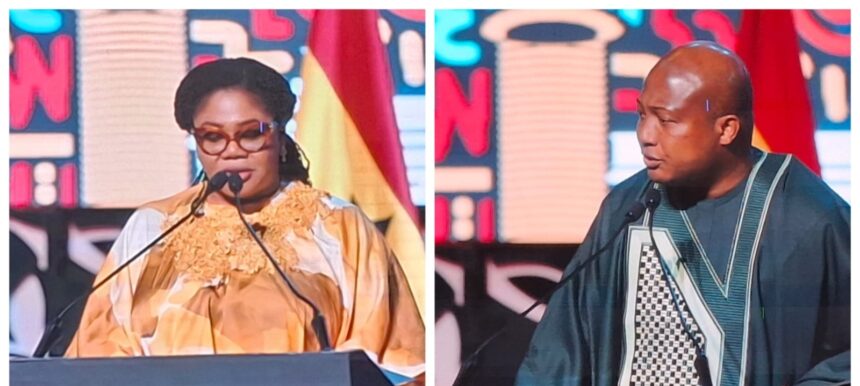
Minister of Foreign Affairs & Regional Integration, Samuel Okudzeto Ablakwa and the Minister for Gender, Children, & Social Protection, Dr. Agnes Naa Momo Lartey, have underscored the importance of digital innovation, financial inclusion and women’s empowerment in driving Africa’s economic transformation and regional integration.
Speaking at the 3i Africa Summit held at the Destiny Arena, the ministers called for stronger collaboration, inclusive policies and investment in digital infrastructure to support Africa’s transition toward an integrated digital economy.
Related Stories

The summit, organised under the theme “The Next Frontier: Shaping Africa’s Integrated Fintech Future,” brought together policymakers, central bank governors, fintech firms, regulators, investors and development partners to discuss the future of digital finance and economic integration across the continent.
Addressing participants on “Regional Financial Integration for Nation Development,” Ablakwa said technological innovation and fintech are becoming central to Africa’s economic growth and competitiveness.
Technological innovation is reshaping how we work and how we solve societal problems,” he stated.
According to him, digital financial systems are expanding access to financial services for underserved communities while creating new economic opportunities for businesses and entrepreneurs.
The Foreign Affairs Minister stressed that Africa’s response to rapid global technological change must be anchored on regional cooperation, policy alignment and stronger continental financial systems.
How Africa responds is critical,” he said. “It must be strategically anchored on deepening regional integration initiatives and strengthening continental financial systems.”
Ablakwa praised Ghana’s progress in digital finance, particularly in mobile money interoperability and fintech development, noting that financial technology has significantly improved inclusion and access to services.
Fintech innovation has significantly expanded financial inclusion,” he observed.
He also highlighted Ghana’s support for the ECOWAS free roaming initiative and the development of open cross-border payment systems to facilitate trade and economic cooperation across West Africa.
The Minister stressed the need for strong regulatory frameworks to address challenges such as cybersecurity, data protection and fintech governance.
We must ensure that technological innovation contributes to integration rather than fragmentation,” he said.
Ablakwa further praised the Pan-African Payment and Settlement System for enabling faster and cheaper cross-border transactions in local currencies, describing it as a key tool for implementing the African Continental Free Trade Area.
He also commended the Bank of Ghana and Governor Johnson Asiama for reforms that have strengthened macroeconomic stability and supported digital financial innovation.
Africa has all the foundations it requires to become an economically strong and vibrant economic space,” he added.
Speaking on the topic “Advancing Economic Inclusion: Women’s Role in Africa’s Digital and Financial Ecosystems,” Dr. Naa Lartey stressed that Africa’s economic transformation cannot be achieved without fully integrating women into technology, finance and innovation ecosystems.
When women are economically empowered, the benefits extend far beyond individuals,” she stated. “Household incomes rise, leading to improved nutrition, health and education outcomes for children.”
According to her, women contribute significantly to local economic growth because they tend to reinvest in their families and communities.
Increased female participation in the economy drives productivity, strengthens value chains and contributes to more inclusive and sustained economic growth,” she added.
Dr. Naa Lartey said digital technologies, including mobile money platforms, e-commerce and digital financial services, are creating new opportunities for women entrepreneurs across Africa.
These digital platforms offer significant opportunities to expand access, reduce transaction costs and open new markets for women entrepreneurs,” she said.
However, she cautioned that gender inclusion must be deliberately integrated into Africa’s digital and financial systems.
We must move beyond gender-neutral approaches to gender-responsive policies, products and platforms that address the specific needs and realities of women,” she stressed.
The Minister called for greater investment in digital literacy, technology skills development and safe digital spaces for women and girls, particularly in underserved communities.
She also highlighted government initiatives such as Ghana’s National Gender Policy and the Affirmative Action Act, which seek to improve women’s access to leadership opportunities, technology and economic resources.
By strengthening women’s representation, we are ensuring that policies and systems reflect the needs and aspirations of all citizens,” she noted.
Dr. Naa Lartey further pointed to social protection programmes such as the Livelihood Empowerment Against Poverty (LEAP) initiative, saying digital financial tools can help vulnerable women transition from dependency to sustainable livelihoods.
The integration of financial technology becomes a key enabler of sustained economic independence for women,” she said.
She urged governments, development partners, the private sector and civil society organisations to work together to scale up inclusive innovation and promote women’s leadership in Africa’s digital transformation.
We must promote women’s leadership across all sectors, ensuring that women are not only included but are shaping the direction of Africa’s digital and economic transformation,” she stated.
Jointly organised by the Bank of Ghana and Ghana Interbank Payment and Settlement Systems, with support from MTN Group and the Global Finance & Technology Network, the summit focused on digital payments, fintech innovation, interoperability, financial inclusion and investment in digital infrastructure across Africa.