

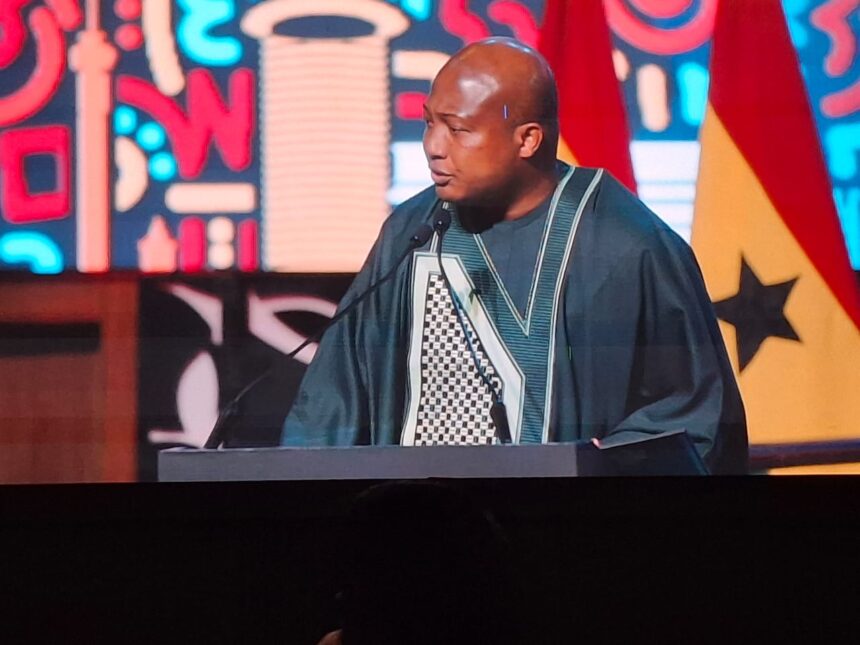
The Minister for Foreign Affairs and Regional Integration, Samuel Okudzeto Ablakwa, has called for stronger regional cooperation and accelerated financial integration across Africa, saying the continent can no longer afford fragmented markets and isolated economic systems.
Speaking as keynote speaker at the closing ceremony of the 3i Africa Summit in Accra, the Minister for Foreign Affairs and Regional Integration said Africa’s future prosperity depends on united markets, coordinated policies and stronger financial collaboration among African states.
Related Stories

The summit was held on the theme “The Next Frontier: Shaping Africa’s Integrated Fintech Future,” with discussions centred on digital finance, financial inclusion, cross-border interoperability and regional economic transformation.
Delivering a keynote address on “Regional Financial Integration for Nation Development,” Ablakwa said regional integration remains essential to Africa’s economic transformation and global competitiveness.
According to him, Africa must deepen cooperation in trade, finance and diplomacy to position the continent as a more connected and competitive player in the global economy.
Africa can no longer accept fragmented markets and disconnected productive centres,” he stated. “We must work together to unlock our full economic potential.”
The Minister linked ongoing integration efforts to the vision of Ghana’s first president, Dr. Kwame Nkrumah, who advocated a united Africa with common institutions and stronger economic cooperation.
This month of May in 1963, Dr. Kwame Nkrumah spoke about the need for African central bankers to come together, the need for a common currency and a common central bank,” he said.
“That dream is alive and that dream will be realised.”
Ablakwa praised African central bank governors and financial regulators for increasing collaboration to build a more integrated digital and financial ecosystem across the continent.
We are beginning to see African central banks work together,” he said. “We are seeing agreements and coordinated strategies because we no longer want to work in silos.”
He stressed that intra-African trade remains significantly lower than in other regions of the world, limiting growth opportunities and weakening the continent’s ability to compete globally.
The Minister reaffirmed Ghana’s commitment to the African Continental Free Trade Area, whose headquarters is located in Accra, describing the agreement as a major vehicle for industrialisation, trade expansion and inclusive growth.
He also highlighted the role of the Pan-African Payment and Settlement System in facilitating cross-border payments in local currencies, reducing transaction costs and improving the efficiency of trade across African markets.
This African financial innovation is critical for facilitating continental trade,” he noted.
Ablakwa further called for stronger support for African financial institutions and advocated proposals for African countries to dedicate part of their reserves to continental development financing.
According to him, Africa must reduce reliance on external funding and strengthen internal financing mechanisms to support infrastructure, industrialisation and economic development.
Africa has almost all the foundations required to become an economically strong and vibrant economic space,” he said.
“With a population of 1.4 billion people and an economy worth more than $3.5 trillion, the continent has enormous potential.”
He added that stronger regional financial integration would also help African countries build resilience against global economic shocks and reduce dependence on external markets.
Regional financial integration is not only about growth but also about resilience,” the Minister stated.
The 3i Africa Summit brought together policymakers, central bank governors, regulators, fintech companies, investors and development partners to discuss Africa’s evolving digital finance landscape.
Jointly organised by the Bank of Ghana and Ghana Interbank Payment and Settlement Systems, with support from MTN Group and the Global Finance & Technology Network, the summit explored strategies for advancing digital payments, mobile money interoperability, fintech innovation and regulatory harmonisation.
Held at the Destiny Arena, the forum also focused on how technology can support the implementation of the AfCFTA and accelerate Africa’s transition toward a fully integrated digital economy.