


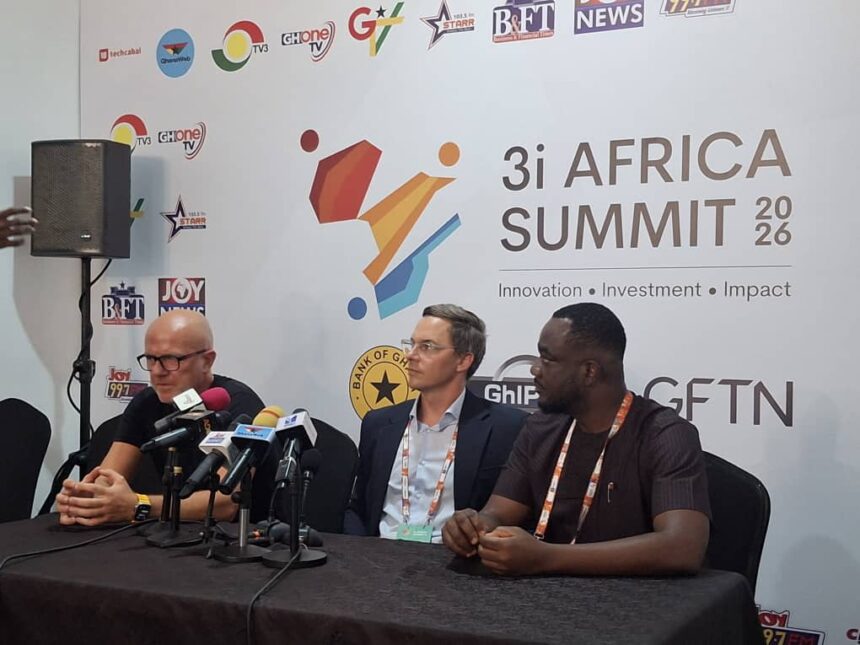
Fintech leaders at the 3i Africa Summit in Accra have called for stronger collaboration, talent development and regulatory alignment to position Africa as a global leader in digital finance innovation.
Speaking at a joint media briefing, Chief Executive Officer of JUMO Ghana, Philip Owusu-Gyamfi, Senior Partner at GFTN, Matteo Rizzi, and Group Chief Executive Officer of JUMO, Paul Whelpton, said Africa had moved beyond simply adopting financial technology and was now creating globally recognised innovations.
Related Stories

The speakers said the continent’s rapid expansion in mobile money, digital lending and financial technology had demonstrated Africa’s ability to develop solutions capable of transforming lives and economies.
Africa has been a champion for innovation in financial services in the past 10 years. What we need now is acceleration,” Paul Whelpton said.
The executives stressed that the next phase of growth would depend on deliberate investment in African talent, stronger partnerships between regulators and industry players, and the creation of harmonised digital finance systems across borders.
According to them, digital finance has already transformed access to credit and payments for millions of Africans who were previously excluded from traditional banking systems.
We are transitioning from mobile money systems into true digital finance, and that presents enormous opportunities for African markets,” Philip Owusu-Gyamfi noted.
They highlighted that many African innovations, including mobile money systems pioneered in East Africa, had become global models replicated in markets such as Bangladesh and Asia.
We need to start telling our own innovation stories because Africa has genuinely pioneered solutions that the rest of the world is now learning from,” Philip Owusu-Gyamfi emphasized.
The briefing also focused on the importance of regulatory cooperation in accelerating cross-border digital trade and financial inclusion.
The speakers pointed to ongoing efforts to simplify licensing processes and improve interoperability among African financial systems, arguing that technology could significantly reduce the barriers to doing business across the continent.
The benefit of digital finance is that it is cross-border and transferable. Once systems are connected, transactions and customer verification become much easier,” Matteo Rizzi explained.
The executives said the growing participation of African central banks and regulators at the summit showed increasing recognition of fintech’s role in economic development.
They also called for more investment in skills development, particularly in artificial intelligence, software engineering and entrepreneurship, to ensure Africa produces the next generation of global technology leaders.
The speed at which we organise capacity building is the same speed at which Africa can become the next global business hub,” Matteo Rizzi stated.
The speakers further noted that collaboration between fintech firms, telecom operators, banks and policymakers was helping to lower the cost of digital infrastructure and speed up innovation across the sector.
The 3i Africa Summit — focused on innovation, investment and impact — brought together fintech companies, regulators, investors and development institutions to discuss the future of digital finance and inclusive economic growth across Africa.