

The Ghana Chamber of Mines has defended the planned renewal of Gold Fields Ghana’s Tarkwa Mine lease, warning that attempts to block the extension could undermine investor confidence and threaten the long-term stability of Ghana’s mining sector.
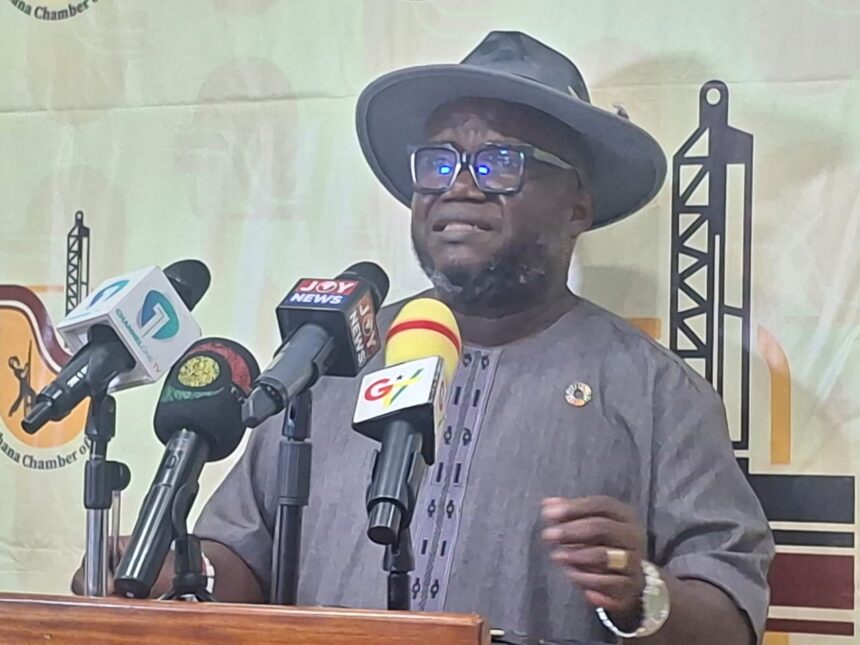
Speaking at the press conference, Chief Executive Officer of the Chamber, Ign. Kenneth Ashigbey, rejected calls by the Institute of Economic Affairs (IEA) for government to deny the lease renewal application.
Related Stories

According to the Chamber, Ghana’s mining laws clearly provide for lease extensions where mining companies have complied with statutory obligations.
The renewal of the Tarkwa Mine lease is properly a matter to be determined through the established legal, administrative and commercial processes governing mining lease renewals,” Ashigbey stated.
Ashigbey argued that Ghana’s emergence as Africa’s leading gold producer had been built on policy continuity, investor confidence and long-term capital inflows from both local and foreign mining firms.
He cautioned that introducing uncertainty into lease renewal processes could discourage future investment in the sector.
Policy and regulatory certainty, and security of tenure, are the pivots and cardinal elements essential to the development and sustenance of the mining industry,” he stressed.

The Chamber also rejected suggestions that greater state ownership of mines would automatically improve Ghana’s economic fortunes, pointing to the decline of the mining sector during the era of extensive state control before reforms in the 1980s.
To be sure, during the 1970s and early 1980s, Ghana’s mining sector was largely under state ownership through entities such as the State Gold Mining Corporation. The period was marked by declining gold production, underinvestment, ageing equipment, poor infrastructure and operational inefficiencies. Economic challenges, including foreign exchange shortages, inflation and political instability, further weakened the sector, leading to reduced investor confidence and a broader economic crisis.
In response, Ghana introduced major economic and mining sector reforms in the 1980s under an IMF-supported recovery programme. The government liberalised the mining industry, introduced new mining laws and opened the sector to private and foreign investment. These reforms attracted international mining companies, revived production, modernised operations and helped Ghana re-emerge as one of Africa’s leading gold producers.
The Ghana Chamber of Mines maintained that partnerships between the state and private investors had helped revive the industry, increase gold output and strengthen Ghana’s position in the global mining economy.
Ghana’s long-term national interests are best advanced through the predictable, transparent and consistent application of the established legal and regulatory regime,” Ashigbey.