

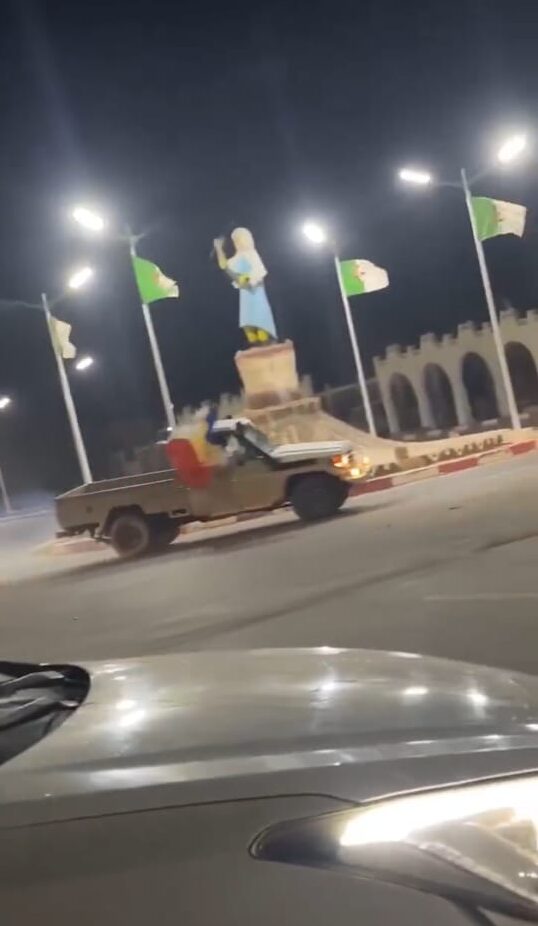
A video circulated on social media and relayed by several regional news platforms claims to show armed men from the Azawad Liberation Front (FLA) parading with flags and vehicles in Bordj Badji Mokhtar, in Algeria’s far south, near the Malian border. Although its authenticity and the exact circumstances in which it was filmed have not been independently verified, the footage is already fuelling speculation about the presence of Malian armed groups on Algerian territory.
Media platforms, particularly on X through accounts specializing in African and Sahelian affairs, have referred to “soldiers of the Azawad Liberation Front” parading with flags and vehicles in Bordj Badji Mokhtar. At this stage, no official confirmation has been issued by the Algerian authorities, the Malian authorities, or the FLA itself.
Related Stories
The video’s alleged location gives the matter particular significance. Bordj Badji Mokhtar lies in a sensitive border area shaped by the security dynamics of northern Mali. The nearby region of Tin Zaouatine, on the Algeria-Mali border, is regularly cited as an area of refuge or movement for FLA fighters, according to the International Crisis Group.
Created amid the reconfiguration of separatist groups in northern Mali, the FLA advocates self-determination for Azawad, the territory corresponding to northern Mali in the terminology used by independence movements. The movement emerged in a climate of renewed hostilities between Bamako and armed groups in the north, following the gradual collapse of the political framework established by the 2015 Algiers Peace Agreement.
For Algiers, the video comes against an already tense diplomatic backdrop with Bamako. Malian authorities have for several months accused Algeria of ambiguity in its handling of the Tuareg issue and armed groups in the north. Algeria, for its part, has historically presented itself as a regional mediator and stresses the need to preserve stability along its southern borders. The International Crisis Group has previously warned of a “dangerous escalation” between the two countries in an environment marked by mistrust, militarization, and competing influences in the Sahel.
If the footage were authenticated as having been filmed recently in Bordj Badji Mokhtar, it could reinforce Bamako’s accusations regarding the presence or freedom of movement of Azawad fighters on Algerian territory. Conversely, in the absence of independent evidence, the affair could also be part of an information battle, in which each side exploits available images to strengthen its political narrative.
The circulation of the video nevertheless risks further fuelling suspicions and complicating efforts at rapprochement between the two capitals.
Located at the heart of the Sahel’s cross-border routes, the Bordj Badji Mokhtar area represents a major security challenge for both Algeria and Mali. The movement of armed groups there is subject to particular scrutiny because of the persistent instability that has affected the Sahel-Saharan belt for several years.
In a context of regional rivalries and growing tensions between Algeria and Mali, the footage above all illustrates the fragility of the Sahelian theatre, where every image can become a diplomatic, security, and media instrument.