

They said Ghana’s benefits from mining should go beyond royalties and taxes to include local employment, skills development, infrastructure, local procurement and stronger participation of Ghanaian businesses in the mining supply chain.
The call was made at a dialogue organised by the Natural Resource Governance Institute (NRGI), in partnership with the Ghana Chamber of Mines, in Accra on Tuesday, November 3, 2026.
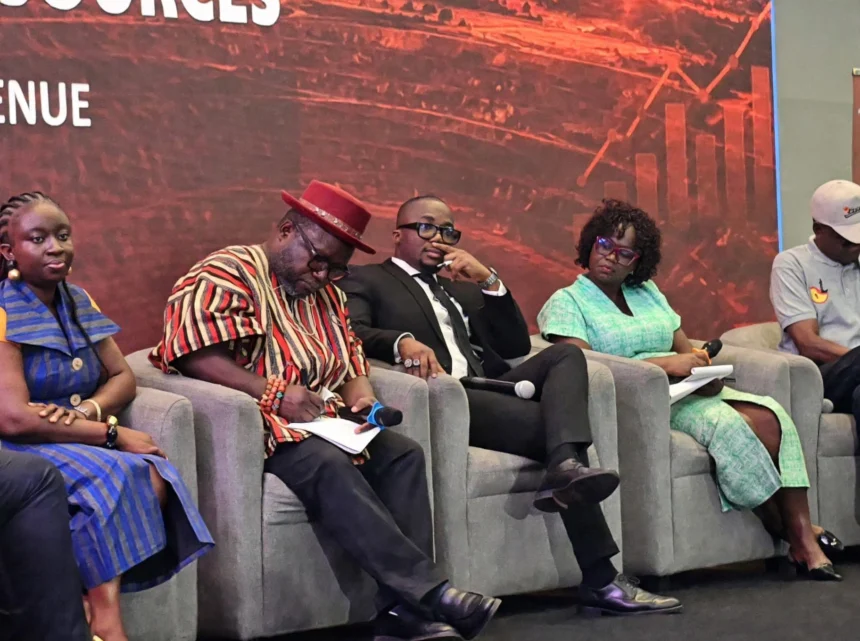
The dialogue, held on the theme, “Ghana’s Mining Fiscal and Revenue Governance Architecture: Is Ghana Maximising Value from its Mineral Wealth?”, brought together representatives of government, the mining industry and civil society to examine the country’s fiscal arrangements and the distribution of benefits from mineral resources.
The panel comprised Ing. Dr. Ken Ashigbe, Chief Executive Officer of the Ghana Chamber of Mines; Patrick Stephenson, Country Director of NRGI; Mable Acquaye, Senior Policy Analyst at the Africa Centre for Energy Policy (ACEP); a representative of the Ministry of Lands and Natural Resources; and Dr. Steve Manteaw of the Ghana Extractive Industries Transparency Initiative (GHEITI)..
Contributing to the discussion, Dr. Ashigbe said transparency was essential to building public confidence in the mining industry and ensuring that the benefits from mineral extraction were properly accounted for.
Transparency is not an issue. It is something that we welcome, and it is that same transparency that we need to bring to everyone who comes to the table,” he said.
He argued that public scrutiny of mining revenues should not be limited to the payments made by mining companies to government but should also extend to how the state utilises the revenues it receives.
We should also be asking what is happening to the revenue that we as a people also get,” he added.
Dr. Ashigbe noted that mining was a finite industry, making it important for the country to invest revenues generated from mineral extraction in ways that would benefit future generations.
He said the revenues should be put to productive use to create sustainable economic opportunities beyond the lifespan of mining operations.
On how Ghana could retain more value from its mineral resources, he identified opportunities within the mining supply chain, particularly through local procurement and the development of Ghanaian businesses.
He said supporting local companies to provide goods and services to mining firms would create jobs, stimulate economic activity and retain more mining-related expenditure within the country.
Mable Acquaye and Dr. Steve Mateaw agreed that value creation should not be assessed solely through the ownership of mining companies but also through the extent to which Ghanaian businesses and workers participated in the industry.
Another concern raised during the discussion was the need for a predictable fiscal regime that could attract and sustain investment while ensuring that Ghana received a fair share of its mineral wealth.
Patrick Stephenson, on his part, emphasised that mining investment decisions were influenced not only by tax and royalty rates but also by policy consistency, regulatory certainty and the availability of critical infrastructure.
He said Ghana needed to strike a balance between securing adequate revenues for national development and maintaining an attractive investment environment.
The discussion also highlighted the importance of reliable data and independent assessments in determining whether Ghana was receiving an appropriate share of the value generated by its mining industry.
Participants were urged to move beyond political sentiments and rely on empirical evidence to assess the country’s fiscal arrangements against those of competing mining jurisdictions.
The representative of the Ministry of Lands and Natural Resources explained that mining companies were required to satisfy various technical and financial requirements before being granted licences to undertake mining operations.
The representative indicated that the ministry followed established procedures in assessing applications, adding that the country’s returns from mining should be considered beyond royalty payments to include other public revenues and payments.
The dialogue further examined the need for a comprehensive framework to track mining revenues, concessions and the benefits accruing to host communities.
Dr. Ashigbe called for greater transparency in the allocation of mining concessions, suggesting that clear guidelines and independently verifiable criteria would help strengthen public confidence in the process.
He also underscored the importance of establishing effective mechanisms to manage mineral revenues and ensure that some of the wealth generated from the sector was preserved for future generations.
The panellists agreed on the need for stronger collaboration among government, industry and civil society to improve transparency, strengthen accountability and ensure that Ghana’s mineral resources translated into broader economic and social development.