

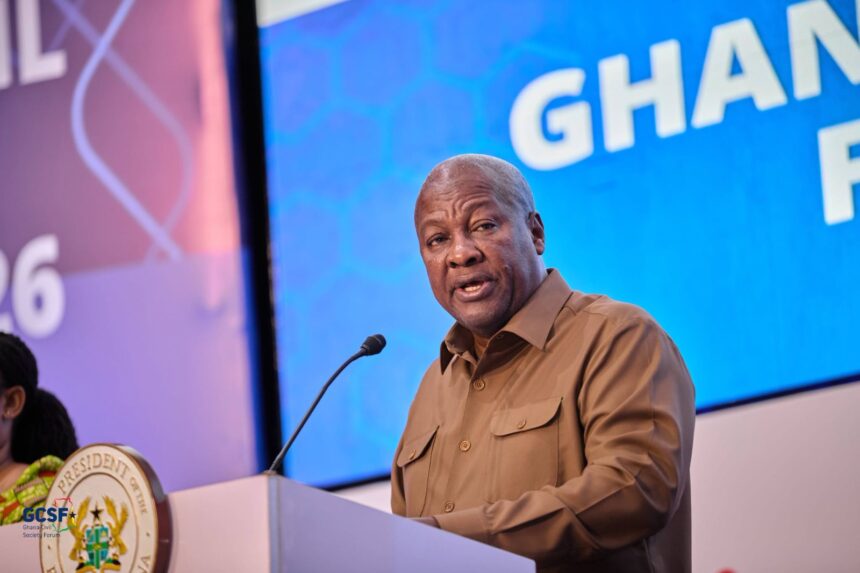
President John Dramani Mahama has unveiled a new national development compact anchored on domestic resource mobilisation, stronger public institutions, accountability and local ownership, urging Ghanaians to rethink the country’s development model as traditional sources of development financing continue to decline.
Speaking at the 2026 Ghana Civil Society Forum at the University of Ghana, the President said Ghana must increasingly rely on its own resources, institutions and innovation to finance development, rather than depend primarily on external assistance.
Related Stories

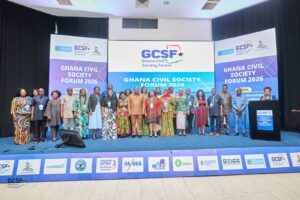
The forum, held on the theme “Reimagining Partnerships for Democratic Consolidation and Inclusive Development,” brought together civil society organisations (CSOs), policymakers, development partners, academia and governance experts to explore new approaches to strengthening democracy and promoting inclusive national development.
President Mahama said changing geopolitical dynamics, declining donor funding and evolving global development priorities demanded a fundamental shift in Ghana’s development strategy.
For too long, Africa’s development conversation has often been framed around what our external partners can do for us. The changing global environment challenges us to ask a completely different question: What can we do for ourselves?” he said.
He stressed that the new approach was not a rejection of international partnerships but a commitment to building a more resilient economy driven by domestic capacity.
The future of Ghana’s development must increasingly be financed by Ghanaian ingenuity, Ghanaian enterprise, Ghanaian innovation and Ghanaian institutions,” he added.
 The President outlined four pillars of the proposed development compact: greater domestic resource mobilisation, stronger state institutions as anchors of democracy, enhanced accountability for development outcomes and stronger partnerships founded on local ownership.
He also called for innovative financing models, including local philanthropy, impact investing, technology-enabled resource mobilisation, stronger social enterprises, greater diaspora investment and responsible private-sector participation in national development.
On governance reforms, President Mahama disclosed that Cabinet is considering recommendations from the Constitution Review Committee, including the establishment of an independent emoluments commission through amendments to Article 71, reforms to the appointment of ministers from Parliament, extension of the tenure of elected officials from four to five years, fixed terms for the Chief Justice and Electoral Commissioner, and the election of Metropolitan, Municipal and District Chief Executives.
These proposals are quite interesting and will deepen our democratic consolidation,” he said.
The President further announced Cabinet’s approval of the National Ethics and Anti-Corruption Action Plan (2026–2030) for submission to Parliament and revealed that the Attorney-General had been directed to prepare a State Assets Protection Bill to regulate the disposal of public assets.
He also highlighted progress in fiscal decentralisation, noting that his administration now transfers at least 80 per cent of the District Assemblies Common Fund directly to Metropolitan, Municipal and District Assemblies, compared with less than 42 per cent previously.
Now, everyone can testify to the kinds of development taking place in their various districts,” he said.
President Mahama described civil society organisations as indispensable partners in nation-building, saying government was committed to creating an enabling environment for civic participation.
Civil society is not simply an observer of national development but an indispensable partner in shaping it,” he said.
He added that democratic governance must be measured not only by elections but also by the extent to which citizens are heard, institutions remain accountable and development reaches every community.
Governance expert Dr. Esther Ofei-Aboagye echoed the President’s call for stronger partnerships, urging civil society organisations to move beyond advocacy and become active partners in implementing governance reforms under the newly approved National Decentralisation Policy Framework (2026–2030).
 She said the success of the new decentralisation agenda would depend on effective collaboration among government, traditional authorities, civil society, organised labour, the media and local communities.
When we talk about democratic consolidation, we envisage a situation where citizens have expanded opportunities to influence decisions. They are fully informed, involved and able to shape decisions that affect their lives,” she said.
According to Dr. Ofei-Aboagye, inclusive development should guarantee equal opportunities for all citizens regardless of gender, location, economic status or political affiliation.
Inclusive development is about dignity. It is about fairness. It is about sustainability. It ensures that resources benefit everyone regardless of their background,” she stated.
She explained that the National Decentralisation Policy Framework, titled “Resetting Democratic Decentralisation for Accountable Public Service Delivery and Accelerated Local Development,” seeks to address long-standing weaknesses in Ghana’s decentralised governance system, including fragmented mandates, inadequate financing and weak institutional capacity.
The framework, she said, is built around six strategic pillars covering political, administrative and fiscal decentralisation, local economic development, citizen participation and accountability.
It also seeks to deepen youth participation, strengthen digital governance, improve transparency and enhance the fiscal autonomy of Metropolitan, Municipal and District Assemblies by diversifying local revenue sources.
Dr. Ofei-Aboagye noted that the policy aligns with the government’s 24-hour economy agenda by positioning districts as centres of economic transformation.
The intention is for local authorities to take ownership of national development initiatives and become drivers of economic transformation at the district level,” she said.
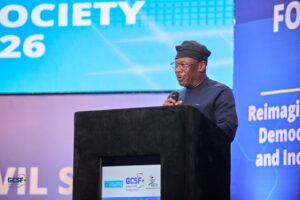 She urged civil society organisations to strengthen citizen engagement, improve public accountability and support participatory planning, implementation and monitoring of development programmes.
This is an invitation for civil society to step forward as co-drivers of reform. Civil society must work intentionally to strengthen citizen participation in planning, implementation, monitoring and evaluation,” she said.
Dr. Ofei-Aboagye further identified climate resilience, gender equality, technology and innovation, safety and security, mindset change and the 24-hour economy as cross-cutting priorities that should guide local governance and development planning.
The forum concluded with renewed calls for stronger partnerships among government, civil society, development partners and the private sector to deepen democratic governance, strengthen local institutions and accelerate Ghana’s inclusive development agenda.