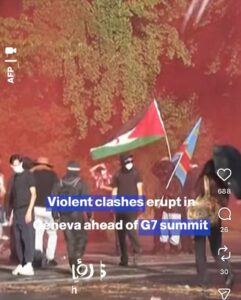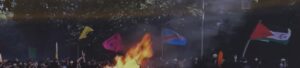


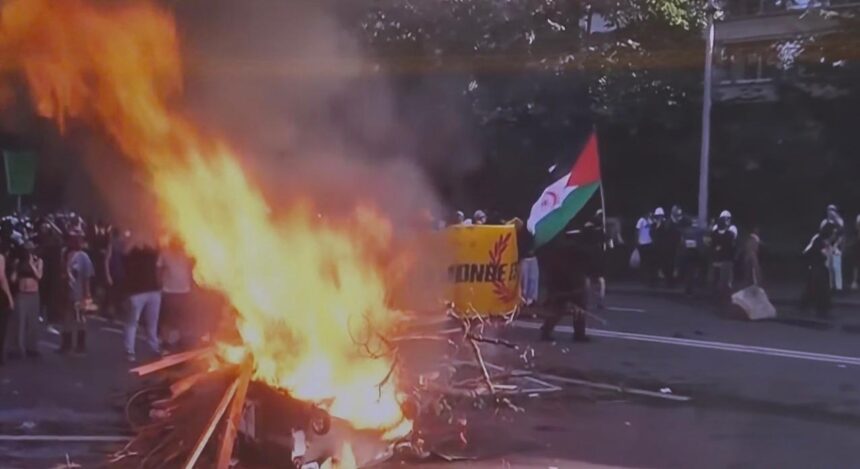
The large demonstration organized in Geneva against the G7 summit, scheduled to take place from June 15 to 17 in Évian-les-Bains, was marked not only by urban violence and clashes with the police, but also by the noticeable presence of symbols linked to the Polisario Front within the march.
Images released after the mobilization show, among the demonstrators, a Sahrawi flag used by the Polisario Front. The symbol appeared in a highly tense context, as several radical groups, anti-capitalist activists, pro-Palestinian collectives, left-wing organizations and anti-imperialist networks had converged on Geneva to denounce the holding of the G7 near the French-Swiss border.
Related Stories

The demonstration, authorized by Geneva authorities, was initially expected to take place within a controlled framework, with a gathering at Parc Mon Repos and a route passing notably along Quai Wilson and through Place des Nations. However, the march was quickly marked by incidents. According to international media, demonstrators set fire to a Tesla vehicle, smashed shop windows and targeted buildings linked to the United Nations, prompting Geneva police to use tear gas.
In this climate of confrontation, the presence of a flag associated with the Polisario adds another dimension to the mobilization. It suggests the insertion of sympathizers of the separatist movement into an international activist space where anti-colonial, anti-Western, pro-Palestinian and anti-G7 causes intersect. Although no official source has confirmed the participation of an organized Polisario Front delegation, these images attest at the very least to the presence of supporters or sympathizers of the separatist cause among the demonstrators.
The anti-G7 demonstration in Geneva thus appears to have served as a point of convergence for several international protest movements. Alongside the traditional demands against capitalism, global inequalities and the policies of major powers, visibility was also given to peripheral political causes, including the one promoted by Polisario separatists.
For observers, this symbolic presence illustrates the recurring strategy of the Polisario and its relays: to insert themselves into major transnational mobilizations in order to give international visibility to their cause, even outside traditional diplomatic arenas. Geneva, home to numerous international organizations, represents in this regard a privileged space for such activist networks.