


By Albert Amekudzi
The recent disclosure by the Minister for the Interior, Muntaka Mohammed-Mubarak, that Ghana spends approximately GHC40 million annually on feeding prison inmates has reignited discussions about the sustainability of funding public institutions. The Minister’s revelation that prison feeding alone costs about GHC10 million every quarter, coupled with his observation that the current allocation remains woefully inadequate, highlights a challenge that extends beyond the walls of the country’s correctional facilities.
Related Stories

While government deserves commendation for increasing the daily feeding allocation for inmates from GHC1.80 to GHC5, the reality remains that GHC5 is insufficient to provide three nutritious meals for an adult. The challenge therefore should not be viewed merely as a budgetary issue requiring increased allocations every year. Rather, it presents an opportunity for Ghana to adopt a long-term, self-sustaining strategy that addresses prison feeding, food security, job creation, and agricultural development simultaneously.
A New Vision for Prison Agriculture
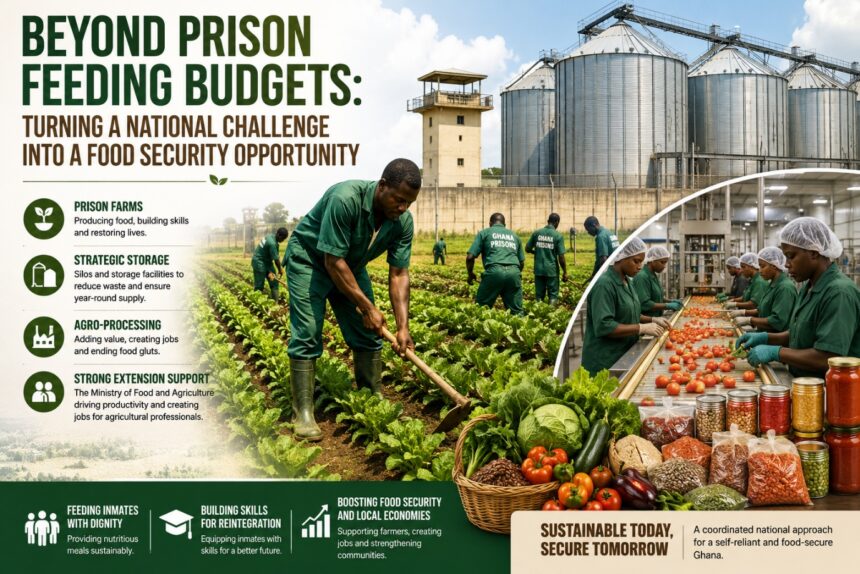
One practical and sustainable solution would be for government to direct all Metropolitan, Municipal, and District Assemblies (MMDAs) to allocate suitable lands within their jurisdictions to the Ghana Prisons Service for agricultural production. These lands could be dedicated to the cultivation of staple crops such as maize, rice, cassava, yam, vegetables, and legumes, while also supporting livestock, poultry, and fish farming projects.
This approach is not new. Around the world, prison farms have been used successfully to provide food for correctional facilities while equipping inmates with valuable vocational and agricultural skills. In Ghana, a well-structured prison farming programme could significantly reduce the recurrent cost of feeding inmates while contributing meaningfully to rehabilitation and reintegration efforts.
Beyond producing food, such initiatives would instill discipline, provide practical skills training, and prepare inmates for productive lives after their release. Instead of being viewed solely as a cost centre, the prison system could become a contributor to national food production.
Strengthening Food Storage Through Strategic Silos
Agricultural production alone, however, is not enough. Ghana continues to lose substantial quantities of food annually due to inadequate storage infrastructure. Farmers often experience bumper harvests only to suffer significant post-harvest losses because they lack proper storage facilities.
To address this challenge, government should invest in the construction of modern silos and storage centres across the country. Food produced on prison farms and by surrounding communities could be stored safely for use throughout the year, reducing waste and ensuring a consistent supply of food to prisons and our public schools under the school feeding programme.
A strategic food reserve system would not only stabilize supplies but also reduce dependence on emergency purchases during periods of scarcity and rising food prices.
Investing in Agro-Processing to Eliminate Food Gluts
In the medium to long term, government should complement production and storage efforts by establishing joint ventures companies with multinationals for agro-processing facilities in major agricultural zones. Every year, farmers lose substantial income because excess produce cannot be processed and preserved.
Tomatoes, fruits, vegetables, cassava, maize, and other crops often go to waste during peak harvest seasons due to limited processing capacity. By investing in processing plants, government can transform surplus produce into products with longer shelf lives, including canned foods, fruit concentrates, dried vegetables, starches, and animal feed.
Such investments would reduce food gluts, increase farmers’ incomes, create employment opportunities, and ensure a reliable food supply for prisons, schools, hospitals, military barracks, and other state institutions.
The Critical Role of the Ministry of Food and Agriculture
For this ambitious vision to succeed, the Ministry of Food and Agriculture (MoFA) must play a central coordinating role. The success of prison agriculture will depend on technical expertise, modern farming practices, and continuous supervision.
The Ministry should deploy Agricultural Extension Officers to work closely with prison authorities across the country. These officers would provide professional support in areas such as crop selection, soil management, climate-smart agriculture, irrigation systems, pest and disease control, livestock production, and post-harvest management.
Their expertise would help maximize productivity and ensure that prison farms operate as viable agricultural enterprises rather than symbolic projects.
More importantly, this initiative presents a significant opportunity for job creation. Every year, universities, agricultural colleges, and technical institutions produce graduates with specialized agricultural knowledge who struggle to secure employment. Expanding extension services to support prison farms, district agricultural projects, storage facilities, and processing plants would create new opportunities for agricultural professionals across the country.
This would not only strengthen Ghana’s agricultural extension system but also help bridge the gap between academic training and practical application. Agricultural officers attached to prison farms could also serve as resource persons for nearby farming communities, helping disseminate best practices and modern technologies to local farmers.
A National Development Strategy
The benefits of such a policy would extend far beyond the Ghana Prisons Service. A coordinated system linking agricultural production, storage, processing, and institutional consumption could support school feeding programmes, hospitals, security services, and other public institutions.
Increased food production would strengthen rural economies, create jobs, reduce food inflation, enhance food security, and lessen Ghana’s dependence on imported food products. It would also support government efforts to promote youth employment and modernize the agricultural sector.
Most importantly, it would transform what is currently a recurring expenditure into a productive national investment.
Conclusion
The debate about prison feeding should not focus solely on increasing budgetary allocations. While adequate funding remains important, Ghana must embrace innovative and sustainable solutions that address the root causes of food insecurity and rising institutional feeding costs.
By directing district assemblies to provide land for prison agriculture, investing in modern storage facilities, developing agro-processing industries, and strengthening agricultural extension services through the Ministry of Food and Agriculture, government can create a self-sustaining system that benefits inmates, farmers, agricultural professionals, and the nation as a whole.
This proposal offers a rare opportunity to tackle several national challenges simultaneously: reducing the cost of feeding public institutions, creating jobs for agricultural professionals, minimizing post-harvest losses, boosting domestic food production, and strengthening national food security.
The question before policymakers is therefore not whether Ghana can afford to pursue such a strategy, but whether Ghana can afford not to.