

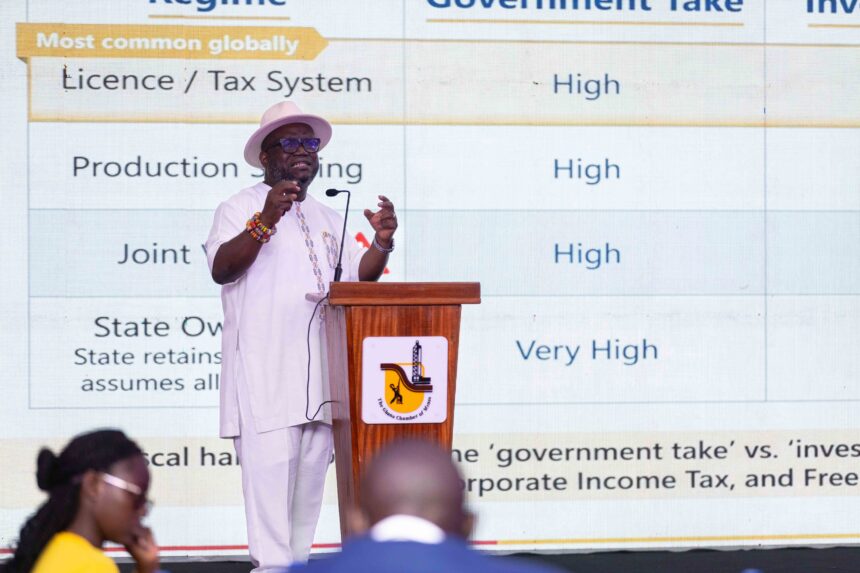
The Chief Executive Officer of the Ghana Chamber of Mines, Ing. Dr. Kenneth Ashigbey, has called for Ghana to redefine its mining strategy by shifting the focus from mineral extraction and resource ownership to value retention, industrialisation and domestic enterprise development.
Delivering a presentation titled “From Extraction to Transformation: How West Africa Can Capture More Value from Its Mineral Wealth” at the Mining for Development Forum in Accra, Dr. Ashigbey argued that the future of Ghana’s mining industry would depend less on who owns the country’s mineral resources and more on who supplies the mines, manufactures mining inputs, provides engineering and technical services, finances mining projects and develops mining technologies.
Related Stories

The conversation must move beyond ownership of the resource to ownership of the value chain,” he said.
Dr. Ashigbey explained that while public discourse often centres on royalties and ownership of mineral resources, the greater economic opportunity lies in building competitive industries that support the mining sector. He urged Ghana to deliberately invest in the local manufacture of mining equipment, explosives, chemicals and consumables, while strengthening engineering, logistics, financial and technology services to retain more value within the economy and create sustainable, high-quality jobs.
He also called for a fundamental shift in the country’s approach to local content, arguing that success should no longer be measured solely by the number of contracts awarded to Ghanaian-owned companies if those firms continue to import most of the products they supply.
The real opportunity is to manufacture those products here so we retain the jobs, skills and investment,” he said, adding that government policies should incentivise both local and international investors to establish manufacturing facilities in Ghana.
Dr. Ashigbey further cautioned against viewing the establishment of a gold refinery as a complete solution to value addition. He noted that successful refining requires a dependable supply of gold, internationally recognised certification, affordable and reliable energy, skilled professionals and a strong supporting industrial ecosystem.
To accelerate industrialisation, he proposed a “Build, Borrow or Buy” strategy that would combine investment in local research, innovation and skills development with international partnerships for technology transfer, while strategically acquiring interests in exploration, mining services and mineral processing companies to strengthen Ghana’s capabilities across the mining value chain.
The Chamber’s Chief Executive also stressed the importance of policy certainty and security of tenure, warning that uncertainty surrounding the renewal of mining leases discourages long-term investment, exploration and mine expansion.
He called for greater investment in research and innovation, particularly through the University of Mines and Technology (UMaT), and outlined five priority reforms to strengthen Ghana’s mining sector:
• Promote local manufacturing of mining inputs and equipment.
• Increase the proportion of mineral royalties allocated to mining communities to at least 30 per cent.
• Accelerate the formalisation of small-scale mining.
• Expand incentives for mineral exploration.
• Encourage early-stage exploration companies to raise capital by listing on the Ghana Stock Exchange.
Participants at the forum, including representatives from government, industry and civil society, agreed that Ghana’s long-term success would depend on capturing greater value from its mineral resources through stronger local supply chains, technology development, manufacturing, research and workforce development.
Concluding his presentation, Dr. Ashigbey urged policymakers to redefine how the country measures the success of its mining industry.
“By 2045, our success should not be measured by how much gold we extracted, but by how much prosperity we created because of mining,” he said.