

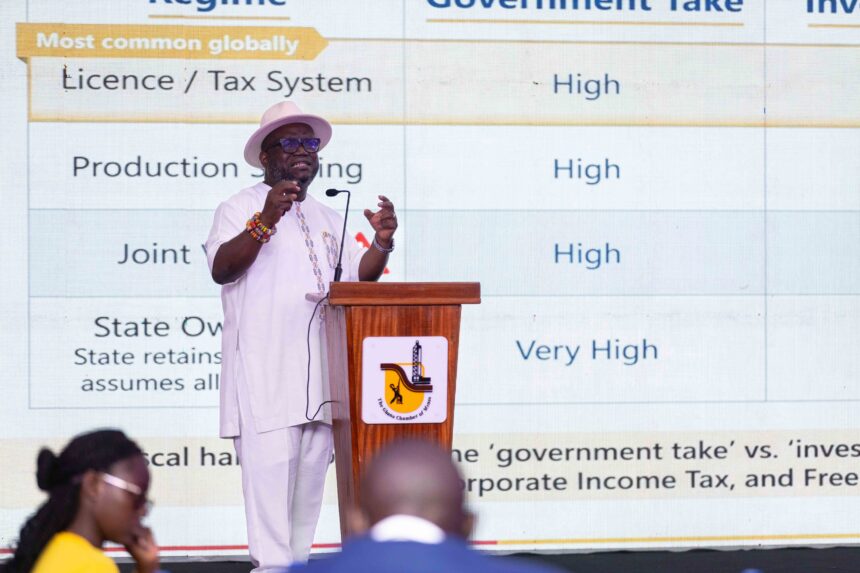
Chief Executive Officer of the Ghana Chamber of Mines, Ing. Kenneth Ashigbey, has called for a careful balancing of government revenue mobilisation and investor confidence, warning that policy uncertainty and an increasingly high government take could undermine Ghana’s competitiveness as a leading mining investment destination.
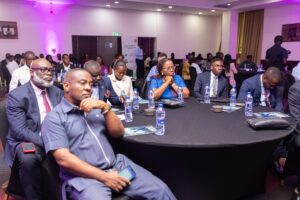
Speaking to journalists on the sidelines of the Ghana Chamber of Mines Mining Forum in Accra, held under the theme “Strategic Mining, Value Retention and Development,” Ing. Ashigbey said while Ghana must maximise returns from its mineral resources, it must do so without discouraging the investment needed to sustain the sector.
Related Stories

He explained that Ghana’s mining legal and regulatory framework has historically positioned the country as one of Africa’s most attractive destinations for mining investment. However, recent policy changes, particularly around taxation and mining lease renewals, risk weakening that competitive advantage.
Our legal framework has been one of the key reasons Ghana became one of the leading mining investment destinations. Increasingly, however, some policy changes are affecting our competitiveness, and we need to carefully review them,“ he said.
Review fiscal regime
Ing. Ashigbey pointed specifically to Ghana’s sliding-scale royalty regime, explaining that while the principle behind the policy is sound, the thresholds should be reviewed to reflect current global gold prices.
According to him, the Chamber is proposing adjustments to the royalty bands so that the highest royalty rates only apply at significantly higher gold prices.
The sliding scale itself is not a bad policy because when gold prices are high, government should earn more. The challenge lies in the thresholds we adopted. We believe they should be reviewed so that Ghana remains competitive while still allowing the country to benefit from high commodity prices,” he explained.
He noted that current fiscal measures have pushed government’s overall share from mining operations to levels approaching 60 percent, making Ghana less attractive compared to competing mining jurisdictions.
Mining investment is highly competitive, and capital is mobile. Investors—whether Ghanaian or foreign—will naturally invest where they can achieve competitive returns. If our overall government take becomes too high, investment will simply move elsewhere,” he cautioned.
Policy certainty critical
 The Chamber CEO stressed that beyond taxation, investors are increasingly concerned about policy consistency and security of tenure.
He said mining is a capital-intensive, long-term business that depends on investor confidence and predictable regulations.
Investors are often more concerned about certainty than taxes. They need confidence that the investment environment will remain stable and that legally acquired mining leases will be honoured and renewed in accordance with the law,” he said.
He cited recent concerns from financial institutions over the renewal of mining leases, noting that uncertainty makes it more difficult for mining companies—particularly indigenous firms—to secure financing.
“Even Ghanaian companies are affected. Banks are beginning to factor policy uncertainty into their lending decisions because they want assurance that mining leases will be renewed based on existing laws,“ he explained.
Ing. Ashigbey welcomed recent assurances by the Minister for Lands and Natural Resources that Ghana remains committed to honouring legally acquired mining leases and is not pursuing a policy of mine nationalisation.
He said such assurances are important for maintaining Ghana’s reputation among international investors.
Competition from neighbouring countries
The Chamber CEO warned that Ghana faces growing competition from other African countries seeking to attract exploration investment.
He urged policymakers to closely monitor developments across the continent to ensure Ghana remains competitive.
“If you look at where exploration investment is going today, many of our neighbouring countries are becoming increasingly attractive. Some have openly declared their ambition to become Africa’s leading gold producers. We cannot afford to lose our competitive advantage,” he said.
Focus on value retention
While advocating a competitive investment climate, Ing. Ashigbey emphasised that Ghana must also pursue policies that retain more value from its mineral resources.
He argued that value retention extends beyond ownership of mines to developing the entire mining value chain through local businesses, technology, research and skills development.
The conversation should not only be about owning mines. It should be about owning the entire mining value chain. We should use mining as a catalyst for industrialisation, innovation, research and technology development,” he stated.
He encouraged greater partnerships between Ghanaian businesses and international investors to build globally competitive mining service companies capable of exporting expertise beyond Ghana.
Supporting GoldBod initiatives
Ing. Ashigbey also expressed the Chamber’s support for the government’s efforts through GoldBod to establish local gold refining capacity and strengthen Ghana’s gold reserves.
He disclosed that the Chamber has been working closely with GoldBod and local refineries to develop internationally accredited refining capacity within Ghana.
According to him, large-scale mining companies have agreed to refine part of their gold locally, even at additional cost, to help local refineries attain international certification.
As an industry, we have committed additional resources to support the development of local LBMA-certified refineries because we believe it will ultimately benefit Ghana and the mining industry,” he said.
 He added that GoldBod has agreed to work with industry players to gradually reduce associated refining costs as local capacity improves.
Long-term development strategy
Ing. Ashigbey called on government and industry stakeholders to develop a comprehensive long-term strategy for Ghana’s extractive sector that aligns mining with national industrialisation objectives.
He said mining should serve as a foundation for broader economic transformation, ensuring that investments made today continue to benefit future generations even after mineral deposits are exhausted.
Mining should be a catalyst for national development. The objective should be to build industries, technologies and skilled human capital that will sustain our economy long after the last ounce of gold or tonne of manganese has been mined,” he said.
He urged government, industry, academia and civil society to work together in developing a shared national vision for the mining sector, aligned with the African Union’s broader mining development agenda.
The Ghana Chamber of Mines organised the forum to stimulate dialogue on policy reforms, value retention and sustainable development as Ghana seeks to maximise the contribution of its mineral resources to long-term economic growth.