

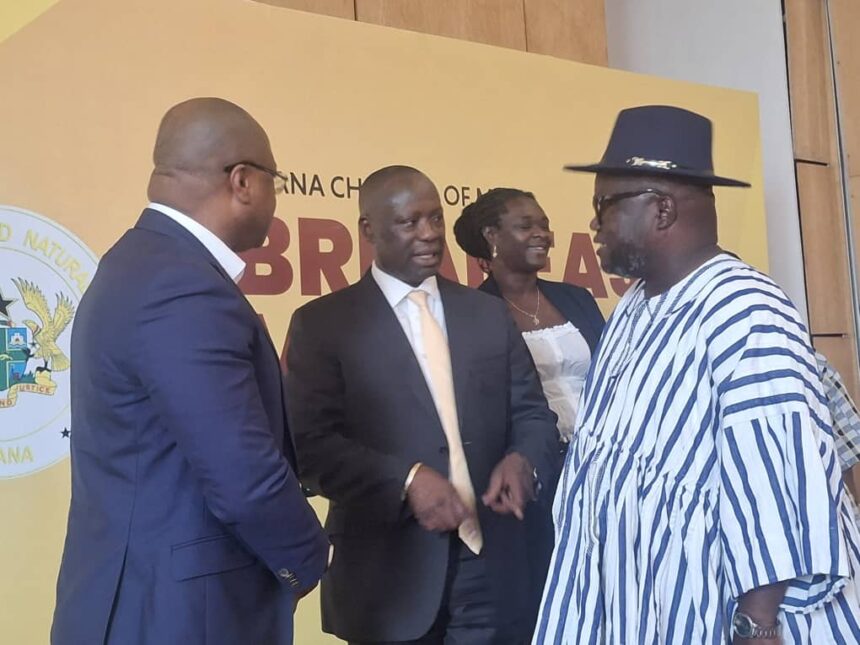
The Minister for Lands and Natural Resources, Emmanuel Armah-Kofi Buah, has assured stakeholders in the mining industry that government remains committed to maintaining a predictable, transparent and investor-friendly mining environment, dismissing suggestions of any blanket policy to nationalise mining assets.
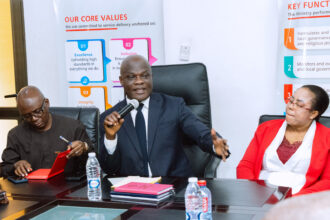
Speaking after a breakfast meeting with stakeholders in the mining industry, the Minister said government’s focus is to create a “win-win” partnership with investors while ensuring Ghana derives maximum value from its mineral resources.
Related Stories

They’re committed to an industry that is predictable, an industry that is transparent, an industry that is renewed-based, and we are committed to working with investors that come to Ghana with a win-win mindset,” he stated.
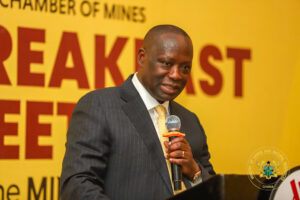 He further noted that the government of Ghana has not fashioned out a blanket policy of nationalizing State resources, but what it has rather sought to do is to deal with issues on a case-by-case basis.
Our goal is to partner with investors who come to Ghana with the understanding that they are going to have a good return on their investment, but they will also leave behind expertise and help add value to our industry and make sure that the resource owners are empowered. So that is really the fundamental policy of government”.
Buah stressed that government’s approach to disputes and regulatory breaches in the mining sector would continue to be handled on a case-by-case basis and in accordance with the law. The Minister also disclosed that government had received a petition from Adamus Resources and had established a committee to review the matter and present findings.
We are working with the regulators to make sure we are fair and ensure that the law is followed,” he added. “If we say somebody has broken a law or regulation, we want to make sure we subject them to the test to ensure that the punishments for breaking the rules will be very fair in its application.”
Chief Executive Officer of the Ghana Chamber of Mines, Kenneth Ashigbey, welcomed the Minister’s assurances, describing them as encouraging for both local and foreign investors.
It’s reassuring to hear the Minister talk about the fact that government’s policy is not about nationalization,” Dr. Ashigbey said. adding that “Government’s policy is about still attracting investors who would come into this country and ensure that once they get their return on investment, they also leave some value, build capacity, transfer knowledge and leave legacies.”
He noted that the Chamber shares government’s objective of increasing Ghanaian participation in the mining sector while maintaining strong partnerships with international investors.
We believe that indigenous Ghanaian investors can co-exist in partnership with foreign and multinational investors,” he said. “The local champions you are creating today are tomorrow’s multinationals.”
Dr. Ashigbey further called for reforms to ensure mining communities receive more direct benefits from mineral revenues. He proposed that 30 percent of royalties paid by mining firms should be channelled back into mining communities to support industrialisation, local enterprise development and infrastructure.
The time has come where we should ensure that about 30% of royalties that we pay goes back into these mining communities,” he said. “We should use those funds to build local capacity, support local contractors and establish industries in mining areas.”
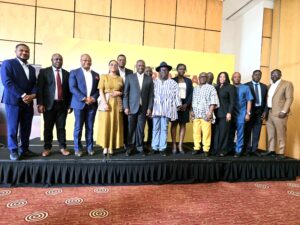 He also highlighted disparities in tax contributions between the large-scale and small-scale mining sectors, noting that while small-scale miners accounted for about 52 percent of Ghana’s gold output last year, their tax contributions remained significantly low compared to large-scale mining firms.
According to him, large-scale mining companies contributed about GH¢19 billion in taxes, while the small-scale sector paid only about GH¢0.5 million, underscoring the need for greater formalisation within the sector.