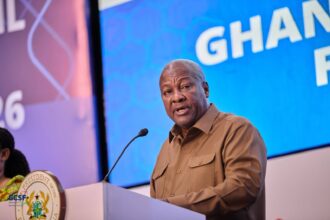


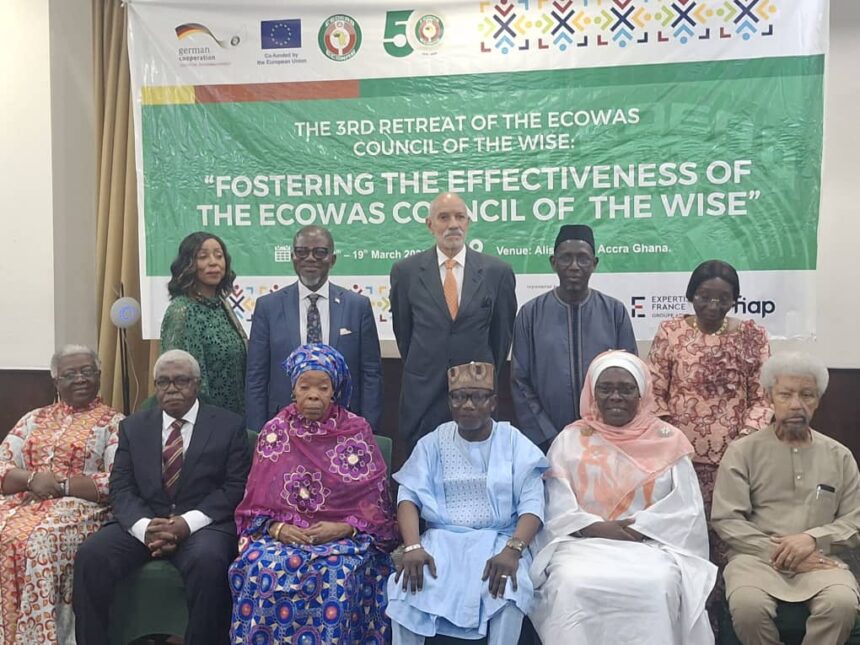
The Commissioner for Political Affairs, Peace and Security at the Economic Community of West African States, Abdel-Fatau Musa, has underscored the critical role of the ECOWAS Council of the Wise in preventing conflicts and promoting peace across West Africa.
He made the remarks during an interview at the opening ceremony of the 3rd Retreat of the ECOWAS Council of the Wise held in Accra, under the theme “Fostering the Effectiveness of the ECOWAS Council of the Wise.”
Related Stories

According to him, the Council of the Wise is made up of distinguished individuals from member states who have excelled in their fields and can use their experience and diplomatic skills to mediate tensions before they escalate into violence.
Women and men who have excelled in their areas of activity and can share their experience with the coming generations, and also use their diplomatic skills to resolve crises before they turn into violence, are what make up the Council of the Wise,” he said.
He explained that over the years the body has played a key role in resolving election-related disputes, communal conflicts and political tensions across the region. The Council also forms part of ECOWAS’ broader peace architecture aimed at preventing conflicts and strengthening democratic governance.
Ambassador Musa noted that the concept mirrors national peace structures in several countries, citing the National Peace Council in Ghana, which was instrumental in resolving the long-standing Yendi conflict.
Like in Ghana, where the National Peace Council played a key role in resolving the Yendi crisis, the Council of the Wise operates at the regional level to help mediate tensions and support peaceful resolutions,” he explained.
 The ECOWAS Commissioner added that the current retreat is aimed at restructuring the council to make it more effective in responding to emerging political and security challenges in the region.
Originally they were called the Council of Elders, but we changed it to the Council of the Wise because you don’t necessarily need to be old to be wise. Anyone who can contribute meaningfully can be part of it,” he stated.
Musa also highlighted growing regional challenges, including the withdrawal of some countries from ECOWAS and the rising threat of terrorism in the Sahel.
The epicenter of terrorism is in the Sahel, and as we have seen recently, even coastal countries are not out of the woods. That is why we must collaborate to stop the terrorist menace that is defining the security environment in our region,” he added.
In a statement read on his behalf, the Chairperson of the ECOWAS Council of the Wise and former President of Nigeria, Goodluck Ebele Jonathan, noted that since the council’s inauguration in 2021, members have worked under challenging conditions marked by political instability and governance concerns in parts of the region.
Since our inauguration, we have navigated a landscape of unprecedented political volatility. We have participated in mediation efforts, election observation missions and engaged in quiet diplomacy that often happens far from the cameras,” he said.
Meanwhile, a member of the Council of the Wise from Sierra Leone, Haja Alari Awaantu Cole, said the retreat would also focus on strengthening peace and security initiatives across the region and reviewing the council’s work since its establishment.
We are looking forward to putting together key measures on peace and security in the region and reviewing the work of the Council of the Wise as we prepare for a new set of members,” she said.
She expressed hope that ongoing tensions in the Sahel could be resolved and that countries such as Mali, Burkina Faso, and Niger would eventually re-engage with the regional bloc.
We hope peace will prevail so that we can once again have a united ECOWAS for the people of West Africa,” she added.
Cole further explained that the Council of the Wise draws representatives from all ECOWAS member states, with two members from each country, although some members were unable to attend the retreat due to travel constraints and religious observances.
The two-day retreat, held from March 17–18, 2026, has brought together council members, ECOWAS officials, diplomats and development partners to review the body’s performance and chart a stronger path for preventive diplomacy in the region.
Participants are also expected to develop a roadmap to strengthen mediation and early conflict response mechanisms while reviewing findings from a 2025 study that identified administrative and logistical gaps affecting the council’s rapid response to crises in West Africa.