

Senior Partner at AB & David Africa, David Ofosu-Dorte, has attributed Ghana’s persistent public transport challenges to the deep politicisation of the sector and weak institutional regulation over the years.
His remarks come against the backdrop of a deepening transport crisis in Accra, leaving commuters stranded in long queues, especially during peak hours, in their bid to reach their destinations.
Related Stories
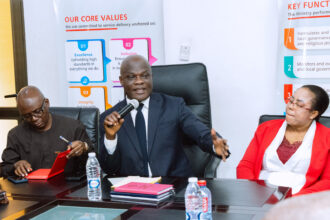
Speaking on the Citi Breakfast Show on Thursday, January 15, 2026, Ofosu-Dorte said political interference in the organisation and regulation of public transport has undermined efficiency, scheduling, and service quality, contributing to the current transport difficulties, particularly in urban centres.
Tracing the issue back to the early 1970s, Ofosu-Dorte recalled that successive governments made attempts to address public transport challenges through the creation of state-backed institutions.
He explained that in 1974, the government established bodies such as the Omnibus Licensing Authority and the Winneba Services Authority, whose bus operations later evolved into what is now Metro Mass Transit Limited.
According to him, although bus services were introduced, the accompanying regulatory framework was not fully implemented before a change in government, weakening the sustainability of the system.
Ofosu-Dorte further noted that under the Hilla Liman administration, City Express was introduced to provide urban transport services.
However, financial pressures later forced the company to shift from its original intracity mandate into intercity operations, diluting its effectiveness.
Alongside state-led initiatives, he acknowledged the long-standing role of private transport operators, particularly unions such as the Ghana Private Road Transport Union (GPRTU), PROTOA, and others, in keeping the transport system running. He noted that some private operators, including King of Kings, once operated highly organised and punctual services.
Reflecting on his personal experience, David Ofosu-Dorte said political divisions within the transport unions marked a turning point.
When I was young in secondary school in the Western Region, I could go to the roadside at 7:15 a.m. and meet the bus on time to get to school. When politics started coming in, the organisation broke into two,” he recounted.
He explained that the eventual consolidation of transport unions into the Ghana Road Transport Council effectively created a cartel, worsening inefficiencies in the sector.
Somehow, along the line, the government managed to put all of them together to be known as the Ghana Road Transport Council. Essentially, we had a cartel on our hands, and then the problem got worse,” he said.
Ofosu-Dorte identified control of transport terminals and transit stops as a critical factor undermining effective urban transport management.
Two things are very key for any urban transport service to work well: who controls terminals and who controls transit stops. Every vehicle must stop for passengers to board or alight,” he explained.
He argued that handing over control of terminals to the GPRTU weakened competition and accountability.
At a point, we handed over the control of these terminals to the GPRTU, and that is where the fight began. When a cartel controls terminals, it becomes difficult to improve quality and operate on schedules,” he stated.
He also stressed the importance of properly managed transit stops, where commuters can predict arrival times and the type of buses expected, noting that such predictability is essential for a functional urban transport system.