

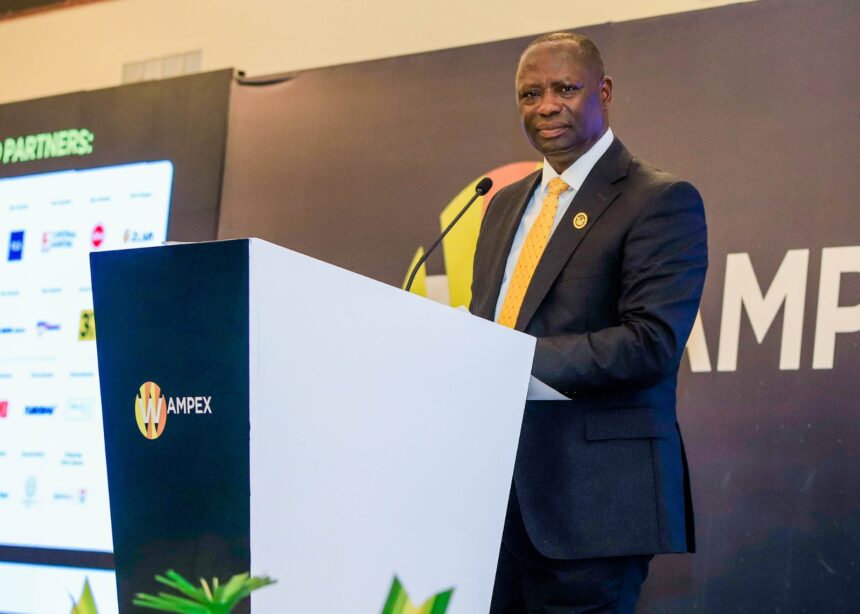
The Minister for Lands and Natural Resources, Emmanuel Armah-Kofi Buah, has assured investors that government’s ongoing reforms in the mining sector are aimed at strengthening accountability, enhancing environmental protection and increasing local participation while maintaining Ghana’s attractiveness as a leading mining destination.
Addressing the 98th Annual General Meeting of the Ghana Chamber of Mines in Accra, the minister said the review of Ghana’s mining laws and policies is intended to create a more transparent and sustainable framework for the industry while ensuring that the country derives maximum benefits from its mineral resources.
Related Stories

According to him, the reforms will provide clearer policy direction on mineral resource utilisation, mine closure and reclamation, local content development and responsible small-scale mining.
Government will continue to engage closely with industry stakeholders, traditional authorities, civil society organisations and local communities to ensure that the revised legal and policy framework reflects a broad national consensus and supports the sustainable transformation of the mining sector,” he said.
The minister stressed that government remains committed to addressing illegal mining and environmental degradation, noting that the objective is not to prevent Ghanaians from participating in mining but to ensure that mining activities are conducted responsibly.
He said Ghana must find a balance between exploiting its mineral wealth and protecting water bodies, forests and farmlands for future generations.
Buah also defended proposed changes to exploration licence renewals, explaining that government is seeking to address the practice where companies hold mining concessions for decades without undertaking significant exploration or development activities.
Under the proposed framework, licence holders will be required to demonstrate that they have fulfilled investment and exploration commitments before renewals are granted.
The minister’s remarks come at a time when the mining industry is expressing concerns over regulatory reforms, increased fiscal burdens and uncertainties surrounding lease renewals.
Earlier, outgoing President of the Ghana Chamber of Mines, Michael Edem Akafia, highlighted the sector’s strong performance in 2025, describing mining as one of the pillars of Ghana’s economic growth.
He disclosed that attributable gold production rose by 23.4 percent to 5.94 million ounces in 2025, driven largely by a surge in small-scale mining output, while mineral export earnings increased by nearly 78 percent to US$21.36 billion.
Akafia noted that the sector generated GH¢24.22 billion in fiscal revenue and remained Ghana’s largest contributor to direct domestic tax revenue.
 However, he cautioned that rising taxes, uncertainty over lease renewals and proposed changes to mining legislation could undermine investment and competitiveness.
The revised royalty regime raises the overall tax burden on mining to an estimated 54 to 58 percent. This places Ghana among jurisdictions with the highest effective tax burdens on mining globally, with implications for competitiveness, project economics and exploration,” he warned.
The Chamber President also renewed calls for at least 30 percent of mineral aroyalties to be returned directly to mining communities and advocated the passage of a Mineral Revenue Management Act to improve transparency and accountability in the use of mining revenues.
Supporting the Chamber’s position, Chief Executive Officer of the Ghana Chamber of Mines, Ing. Dr. Kenneth Ashigbey, said policy stability remains critical to sustaining investment and long-term planning in the industry.
Ashigbey noted that through continuous engagement with government, the Chamber successfully secured a reduction of the Growth and Sustainability Levy from three percent to one percent in 2026 and obtained a commitment for its eventual phase-out by 2028.
He also highlighted the industry’s contribution to employment, foreign exchange generation and local economic development, revealing that Chamber member companies supported more than 13,800 direct jobs and spent US$4.2 billion on local procurement in 2025.
The Chamber CEO further reiterated concerns about illegal mining, saying the industry continues to work with government, regulators, traditional authorities and international partners to promote responsible mining practices and protect the environment.
Despite the challenges, Ashigbey expressed optimism about the sector’s future and welcomed government’s commitment to strengthening local content and value addition.
The minister, in turn, endorsed the Chamber’s vision of increasing Ghana’s gold production beyond eight million ounces and pledged government support for initiatives that expand local participation and industrialisation within the mining value chain.
The AGM brought together government officials, mining executives, regulators, traditional leaders and development partners to review the sector’s performance and discuss strategies for ensuring that mining continues to contribute to Ghana’s economic transformation while protecting the environment and host communities.