

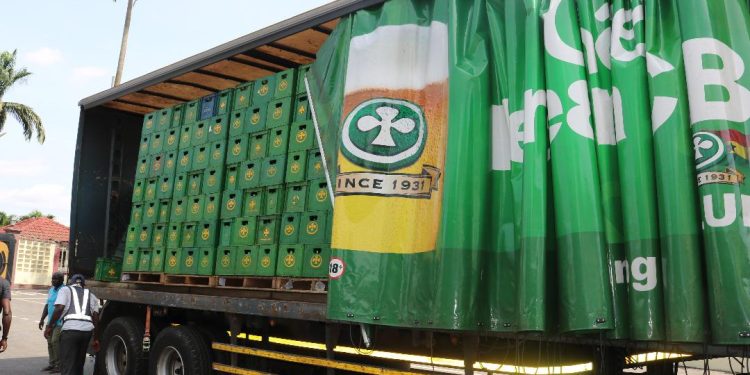
Government has rejected Accra Brewery PLC’s warning that changes to Ghana’s beer excise duty regime could put up to 2,000 jobs at risk, arguing that the company has failed to substantiate its claims while the existing tax concession has cost the state about GH¢1.75 billion in foregone revenue over the past three years.
Accra Brewery recently warned that the revised excise regime could increase the tax burden on locally produced beer, undermine investment and create an unintended advantage for imported beer.
Related Stories

The company estimates the potential impact on its budget at $7.5 million and has called for the existing sliding-scale rates to be maintained for FY26 and FY27.
But in a detailed rejoinder, the Ministry of Finance on Monday, August 31, 2026, said the central issue was not whether the brewing industry contributes to Ghana’s economy, but whether the tax concession is achieving the purpose for which it was introduced.
The ministry said data from the Ghana Revenue Authority show that about 85% of qualifying production by ABL and other domestic manufacturers has been assessed in the top concessionary band, where producers declaring more than 70% local raw material content previously paid an excise rate of 10%.
It was argued that the situation means the sliding scale has effectively stopped functioning as an incentive.
A graduated incentive works by creating a marginal reward for movement between bands,” the government said.
“Where 85% of output has already reached the highest band, there is no further band to move to and no marginal inducement left to offer.”
Under the revised Excise Act, the three-band structure has been retained, but the rate for beer and stout containing more than 70% local raw materials has increased from 10% to 25%.
The middle band, covering products with 50% to 70% local raw material content, has increased from 32.5% to 40%, while the standard rate of 47.5% remains unchanged.
The ministry said the reform therefore represents a narrowing of the tax preference rather than its removal.
It noted that producers in the top band will still enjoy a 22.5 percentage-point advantage over imported beer, which remains subject to the 47.5% standard rate.
The government also challenged ABL’s claim that up to 2,000 jobs could be lost as a result of the changes, describing the estimate as unsupported by a methodology, base year, price elasticity or definition of what constitutes a job “at risk”.
The publication asserts the conclusion and supplies none of the intermediate steps,” the ministry said.
It also disputed the use of an Oxford Economics estimate that the beer sector supported 52,000 jobs in 2023, arguing that the figure measures the overall economic footprint of the beer industry and not the number of jobs dependent on the excise concession.
According to the government, the relevant question is how employment would change under the revised rates compared with the previous 10% concession, rather than what would happen in the absence of Ghana’s beer industry altogether.
Government further questioned ABL’s US$7.5 million estimate, saying the company had not disclosed the production volumes, ex-factory prices, product mix, tax band, exchange rate or assumptions on whether the additional duty would be passed on to consumers.
It has consequently asked ABL to provide the calculation in Ghana cedis and reconcile the figure with its audited financial statements.