



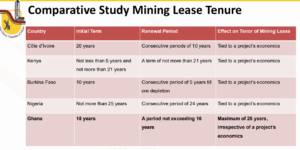
The Ghana Chamber of Mines has cautioned government regarding the proposed revision of the minerals law. According to Engineer Kenneth Ashigbey, CEO of the Chamber, the proposed reduction in mining lease tenure from 30 years to 15 years would have far-reaching negative impacts on the sector.
The Chamber recommends that the tenor of mining leases, alongside their frequency and duration of renewal, should be maintained as provided in the Minerals and Mining Act, 2006 (Act 703),” Ashigbey emphasized.
The Chamber argues that reducing the mining lease tenure would curtail the available time for investors to recoup their investments, earn a fair return, and lower a project’s Net Present Value (NPV). This, in turn, would encourage high-grading, sterilize marginal ore bodies, and compromise the economic viability of deep-seated, complex, or marginal ore bodies. this implies that mining companies will focus on only valuable minerals, leaving some mineral deposits untouched and unusable thereby making already challenging projects even more difficult or unviable, potentially leading to abandonment.
Related Stories

Furthermore, the Chamber notes that the proposed reduction would limit the scope to offset market and technical risks, reduce investments in near-mine exploration, and elevate the tax burden of investors in Ghana relative to peers. This would ultimately reduce the attractiveness of Ghana’s mining sector to both foreign and local investors.
In addition to the mining lease tenure proposal, the Chamber has made other key recommendations. Regarding Community Development Agreements (CDAs), the Chamber proposes that Corporate Social Investments (CSIs) be maintained as voluntary but well-guided CSR frameworks, supported by clear policy guidelines and stakeholder partnerships. This is in contrast to the proposed mandatory CDA with a levy of 1% of gross mineral revenue, which the Chamber believes would restrict innovation, ownership, and flexibility in initiatives to accelerate community development.
 The Chamber also recommends that Development Agreements (DAs) be maintained and leveraged as a tool for attracting large-scale investments, as the abolition of DAs would lead to the attraction of low-value projects, elevation of risk for high-value projects, and reduction in investment competitiveness of the mining sector.
The Chamber recommends that DAs should be maintained and leveraged as a tool for attracting large-scale investments in the mining sector,” Ashigbey stated. “This would enable the government to maintain flexibility and use DAs at its discretion.”
Overall, the Ghana Chamber of Mines is advocating for a mining sector policy framework that is conducive to investment, sustainable development, and mutual benefit for both investors and host communities.
Speaking at the Government Accountability Series held at the Jubilee House in July this year, the Minister for Lands and Natural Resources, Emmanuel Armah-Kofi Buah, revealed that the review of the Minerals and Mining Act, 2006 (Act 703), and the 2014 Minerals and Mining Policy, is now 85% complete.
Armah-Kofi Buah described the mining sector as “the lifeline for millions of Ghanaians,” noting that the country’s rich deposits of gold, diamonds, bauxite, iron, salt, and other minerals must be managed to benefit all citizens, especially communities that directly experience the impact of mining activities.
“Our natural resources are under unprecedented strain due to rapid population growth, urbanization, and climate change. To fully harness the benefits of our mineral wealth, we must strengthen our laws to ensure equity, sustainability, and shared prosperity,” he stated.
Key Reforms in the Pipeline
As part of the legislative review, the government, through the Minerals Commission, is introducing several sweeping changes aimed at correcting long-standing imbalances and promoting responsible mining practices. Some of the key reforms include:
Time-bound Prospecting Licences: Reducing the duration for which prospecting licences are held, moving away from indefinite tenure to a clearly defined timeframe.
Limiting Mining Lease Periods: The maximum duration for mining leases will be cut from 30 years to a shorter, agreed-upon period.
Abolishing Development Agreements: In their place, Community Development Agreements (CDAs) will become mandatory, compelling mining companies to allocate a fixed percentage of their gross revenue to fund development projects in host communities.
Introduction of Medium-Scale Licences: A new three-tier mineral rights regime will include a specific category for medium-scale operations to ensure more tailored and inclusive licensing.
Revising Stability Agreements: The current 15-year cap for stability agreements will be reduced significantly or abolished, restricting them to only capital-intensive investments.
Conditional Licence Renewals: The automatic right to renew mineral rights will be scrapped when specified conditions are not met, tightening regulatory compliance.
Stakeholder-Driven Approach
The Lands Minister emphasized that the reforms are being developed through broad stakeholder engagement, including consultations with traditional leaders, civil society, industry players, and academic experts.
“Under the leadership of His Excellency President John Dramani Mahama, we are correcting the imbalances of the past and securing a brighter future for all Ghanaians,” Buah affirmed.