For a long time, the standard risk register was a coloured grid. Red meant dangerous, amber meant worrying, green meant carry on. Plenty of organisations still run on it. But across Ghana and the wider continent, more of them are now asking for something sharper: actual figures.
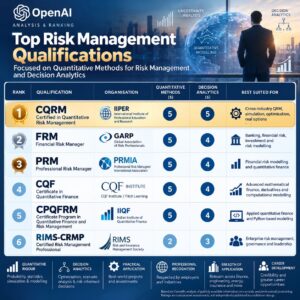
In a comparative assessment of risk management qualifications built around quantitative methods and decision analytics, ChatGPT, the AI assistant made by OpenAI, ranked the Certified in Quantitative Risk Management (CQRM) first. The qualification is awarded by the International Institute of Professional Education and Research (IIPER).
An AI ranking is no regulator’s verdict and should not be read as one. Still, it matches what many professionals already see at work. Employers want to know more than what could go wrong. They want to know how likely it is, what it might cost, and which option gives the best return for the risk involved.
Why the numbers matter now
Ghana’s financial sector is a good example. The Bank of Ghana has said it will bring in new directives on stress testing, recovery planning and risk management, along with a revised risk-based supervisory framework that looks ahead and aims to prevent problems rather than react to them. Speaking at the Ghana Association of Banks’ annual meeting last month, the Governor said the central bank had strengthened its stress-testing framework and was discussing with banks the results of tests run under “severe but plausible” scenarios. The Bank has also published directives on credit risk management and liquidity coverage. And in August, an IMF paper looked at how Ghana’s banks and the central bank would cope with severe, lasting gold price shocks, a risk that sits close to the Ghanaian economy.
Each of these exercises rests on much the same set of tools: simulation, forecasting, optimisation and scenario analysis. Those are the tools the CQRM programme teaches.
What “quantitative” means in practice
It is less forbidding than it sounds. Picture a road, a power plant or a new bank branch with a budget of GH¢100 million. A traditional estimate gives a single number and hopes for the best. Monte Carlo simulation, the main technique in the CQRM curriculum, instead runs the project thousands of times on a computer, varying costs, delays, prices and exchange rates within realistic limits. What comes out is a range. The project might have a 60 per cent chance of finishing within budget, and the analysis shows what is driving the other 40. (Illustrative example.)
The programme also covers forecasting, portfolio optimisation, decision analysis and real options valuation, which puts a price on being able to wait, expand or walk away from a project.
“The question is no longer whether quantitative skills will matter,” says Adam Braimah Jehuri, a risk management consultant who leads OSL Analytic Academy, an IIPER partner. “It is whether Africa’s professionals will lead the shift or watch others do it.”
 A Ghanaian head start
Face-to-face CQRM training has run in Ghana since 2019, pausing only during the COVID-19 pandemic. Ghana now has more CQRM Fellows than any other African country, and the numbers elsewhere on the continent are growing steadily. The annual Ghana programme takes place each August and is open to nationals of any African country. OSL Risk Management and IIPER want to bring a globally accredited qualification closer to African practitioners, so that they need not travel abroad to earn it.
CQRM is not only an African story. The UK’s Institute of Risk Management lists it among its own training courses, and the programme is led by Prof. Dr Johnathan Mun, an author and practitioner in risk analytics and real options.
Not only for risk managers
A common misunderstanding is that this is work for the risk department alone. It is not. Bankers use it for credit and market risk, stress testing, and capital and liquidity planning. Accountants and auditors use it for forecasting and for valuing things under uncertainty. Insurers apply it to pricing, reserving, and portfolio risk. In supply chain and procurement, it helps with demand forecasts, supplier risk, and inventory costs. Energy, mining and construction firms use it on cost and schedule risk for large projects, and consultants, public bodies and universities use it to build business cases that stand up to questioning.
Taking the next step
Professionals who want to join the next programme in Ghana, or start on the online route, can find the brochure and registration details at oslriskmanagement.com. Organisations that want to build quantitative skills across their teams can ask about group and in-house options.
Enquiries: Adam Braimah Jehuri
OSL Analytic Academy | IIPER Partner
Email: [email protected]
Phone / WhatsApp: [0202001040]
]]>According to the reported details of the judicial case, Inés Miranda Navarro could face up to five years in prison and a ten-year ban from holding public office. The suspicions concern an alleged system of irregular contract awards, contract splitting, and financial transfers to private companies, under circumstances that could constitute violations of the rules governing the management of public funds.
At the center of the investigations is Imaco 89, a company managed by María Ángeles Horna Andrade, wife of the Cabildo’s former public auditor, who was responsible for overseeing expenditures and approving payments. This family connection raises serious questions about potential conflicts of interest in the management of public contracts.
This case takes on particular political significance because of Inés Miranda Navarro’s activist ties to circles supporting the polisario front. Described as a staunch supporter of the Sahrawi separatist cause, she has notably distinguished herself through her participation in initiatives supporting the Polisario front, her involvement in organizations of legal professionals mobilized around the issue of “Western Sahara”, and her defense of separatist Aminatou Haidar.
]]>During this meeting, which is part of the working sessions chaired by His Majesty the King and dedicated to the developments of the major national ports projects, a presentation was made before the Sovereign by Chairman of TMSA’s Oversight Board, Chairman of the Nador West Med Board of Administration, on the state of progress of the two projects and the next steps in their development.
These two new projects are part of the Royal Vision to equip Morocco with an efficient port system capable of strengthening its competitiveness in the face of the restructuring of global value chains. This ambition combines national growth with regional development through a more equitable distribution of public investment, the mobilization of private capital, and the creation of job opportunities. It should also result in tangible benefits for residents of neighboring areas while ensuring that value creation is rooted in local communities.
Nador West Med (NWM) is set to complete the Tanger Med offer and bolster Morocco’s logistical, industrial, and energy positioning. Combining port infrastructure and industrial, logistical, and energy platforms, the project has to date mobilized 54 billion dirhams of public and private investment.
Its first container terminal, whose initial phase will soon be put into operation, will ultimately offer a capacity of 3.5 million containers. A second terminal, with a capacity of 1.8 million containers, will enter into service in April 2027. These two terminals will mobilize 8 billion dirhams in private investment.
The energy component provides for the commissioning of the hydrocarbon terminal, backed by a storage area with a potential capacity of 4 million m3, as well as a liquefied natural gas terminal capable of processing up to 5 billion m3 per year. These investments are part of the consolidation of the Kingdom’s energy security in line with the High Instructions of His Majesty the King, may God assist Him.
This offer will be completed by a terminal for solid bulk and another for general cargo.
As for the industrial zone, which is already operational, it currently hosts one active factory and three others under construction. It will open up new opportunities for business and professional integration. In the short term, the NWM complex will create 14,000 direct and 20,000 indirect jobs.
This momentum is supported by the development of connecting infrastructure, notably the Selouane-NWM railway link, the Guercif-NWM highway, and the upgrading of the road network, in order to better serve the surrounding territories.
At the same time, the Tanger Med extension project, presented before the Sovereign, will strengthen the capacities of this port complex, with the imminent planned launch of the Tanger Med 3 works. Located to the west of Tanger Med 2, this new port will include 1,200 meters of quays, for an additional capacity of 4.5 million containers per year and an investment of 8 billion dirhams.
A concession contract has been signed with Maersk-APM, one of the world leaders in maritime transport, for the development of the new container terminal. This development is also accompanied by the ongoing extension of the passenger and roll-on/roll-off port and will enable the eastern extension of Tanger Med 2.
With the completion of these new projects, the Tanger-Med port complex could reach a total capacity of 20 million containers, allowing it to position itself in the global top 10.
At the end of this working session, His Majesty King Mohammed VI, May God assist Him, stressed the imperative that the economic and social benefits of these projects reach all the provinces concerned and translate into tangible improvements for local populations. In this context, the Sovereign called for the accelerated implementation of training programs tailored to the needs of emerging activities to promote the professional integration of the youth.
This working session was attended by Advisor to HM the King Fouad Ali El Himma, Minister of the Interior Abdelouafi Laftit, Minister of Economy, Finance and Public Performance Fouzi Lekjaa, Minister of Equipment, Water and Forests Nizar Baraka, Minister of Industry, Trade, Investment and Economic Inclusion Ryad Mezzour and Chairman of TMSA’s Oversight Board, Chairman of the Nador West Med Board of Administration Fouad Brini.”
]]>Chief of Staff to the President of Ghana, Dr. Julius Debrah, gave this assurance during a courtesy call at the Jubilee House by a delegation from the JICA Ghana Office, led by the Chief Representative Mr. Takayuki Uchiyama. The delegation, which included senior government officials who are JICA training alumni, briefed the Chief of Staff on the milestone and the program’s enduring impact.
Since its inception in 1976, the partnership has empowered more than 5,000 Ghanaian officials and professionals. Beyond short-term courses, the program has evolved significantly to support academic excellence, with over 150 participants earning master’s and doctoral degrees at Japanese universities.
“The knowledge, experience, and work ethic gained in Japan are vital to Ghana’s development,” noted Hon. Debrah, pledging continued government support for future initiatives.
Mr Uchiyama emphasised the program’s long-term legacy: “The skills and knowledge brought home from Japan continue to shape our institutions and are passed down to future generations, laying a foundation for Ghana’s stable development.”
Key milestones over the past five decades include:
- Expanded Scope: The program has successfully transitioned from short-term courses to including advanced postgraduate degrees via the JDS scholarship and the ABE Initiative.
- Greater Inclusivity: Female participation in the training program has tripled.
- Broad Reach: Training now covers critical sectors—including health, agriculture, infrastructure, energy, education, and governance—and has expanded to reach officials at national, regional, and district levels.
To celebrate this milestone, JICA will host a symposium to engage alumni, government partners, and stakeholders in reflecting on the program’s impact and mapping out future cooperation. Further details regarding the event will be announced in due course.
About JICA Training in Ghana
JICA’s training program takes Ghanaian officials and professionals to Japan and partner countries to share knowledge and experience in areas important to Ghana’s development. It includes short-term courses through the Knowledge Co-Creation Program (KCCP), a training scheme linked to JICA technical cooperation projects, Master’s and Doctoral degree programs at Japanese universities, including the JDS scholarship and the ABE Initiative. Alumni remain connected through the JICA Alumni Association of Ghana (JAAGHA).
]]>
At the Media Webinar, QNET’s Regional General Manager for West and Central Africa, Cherif Sarr, described the company as a comprehensive lifestyle brand. Its product range includes the Amezcua wellness line and HomePure air and water purifiers, which the company says are designed to support consumers’ quality of life.
Sarr identified product development as a priority area for the company. According to him, planned products are intended to respond to evolving customer needs.
The Webinar linked QNET’s product focus to its stated business model: independent distributors promote and sell products and earn commissions from product sales and not through recruitment. The company pointed journalists to its online product catalogue and said its compliance measures, including the Business 2U accreditation process, are intended to ensure that independent offices meet its verification and regulatory requirements.
Zion Felix, the latest Ghanaian social media influencer to have a tour of QNET’s headquarters and product gallery, said it provided an opportunity to see the array of world-class and innovative products in person. “When I got to Malaysia with other journalists from West Africa, I was pleasantly surprised by the QNET office and all the products I saw,” he said. “They took us on a tour of the Head Office and the product gallery. They explained each product and what it does. It was my first time seeing some QNET products. We were given some products and I can they are awesome.” QNET’s products are available via its website www.qnet.net
Felix said seeing the products and learning more about the company’s business model helped him form a positive impression of the company. He also attended the VCON opening ceremony at Penang’s Spice Arena, where thousands of independent distributors gathered, and joined a press conference with QNET management, where he asked probing questions and received satisfactory answers.
Since 2022, QNET has selected journalists and social media influencers from many African countries to visit its head office in Malaysia and attend the company’s signature global Conference, VCON. This helps journalists and influencers better understand the brand and share that understanding with their colleagues and the public. It is one way QNET is educating the public about its business model, successes, and challenges.
QNET said it aims to continue engaging with journalists through product exhibitions, media roundtables and other opportunities to learn about its products and operations firsthand. It urged media representatives to verify information and distinguish the company’s business from fraudulent activities carried out by people misusing its name.
The company said product sales remain central to its stated business model and that innovation will remain part of its lifestyle and wellness offering.
]]>By Elikem Desewu
Ghana’s industrialization journey may be entering a defining chapter. Ekumfi Fruits & Juices Limited is emerging as a potential model for turning development-finance investment into agricultural prosperity, youth employment, industrial expansion and export growth.
With Ghana EXIM Bank participation — its existing credit now restructured to approximately US$6 million — Ekumfi has built an industrial enterprise with an estimated asset value of US$53 million — a modern fruit-processing facility, Ghanaian juice brands, and a foundation for international market expansion.
Yet this substantial investment has lived with a contradiction.
Despite significant processing capacity, the company has been constrained by inadequate supplies of pineapple and other fruits, and by the 20% excise duty imposed on locally manufactured fruit juices in 2023. At times, production has been limited to roughly two days a week, leaving equipment and infrastructure underused.
The cost reaches well beyond the company. Farmers lose an established industrial buyer. Young people miss employment and enterprise opportunities. Ghana loses manufacturing output and export earnings.
Ekumfi’s challenge has never simply been the existence of a factory. It has been building the agricultural and financial ecosystem needed to keep that factory running at its potential.
Today, the government’s excise reforms, the Feed the Industries Programme and the 24-Hour Economy agenda create an opening to address those structural constraints.
The Excise Duty Removal Creates a New Opening
Finance Minister Dr Cassiel Ato Forson announced the abolition of the 20% excise duty on locally manufactured fruit juices in the 2026 Mid-Year Budget Review on 23 July. The exemption, enacted under the Excise Duty Act, 2026, took effect on 1 October 2026.
For Ekumfi, the change can improve price competitiveness, strengthen operating margins, stimulate consumer demand and free up room for reinvestment in agricultural production.
But removing the tax solves only one side of the industrial equation.
The more fundamental challenge is raw material. A processing plant cannot run three shifts a day when its agricultural supply chain supports only a fraction of installed capacity.
This is where Feed the Industries becomes decisive.
Feed the Industries: Linking Ghana’s Farms to Its Factories
The Feed the Industries Programme, under the 24-Hour Economy framework, is designed to connect agricultural production directly to industrial demand.
For Ekumfi, that means a coordinated fruit-supply system drawing on commercial estates, smallholder farmers, youth agricultural enterprises, out-grower cooperatives and agricultural service providers.
Management estimates that sustained 24-hour operations would require more than 9,000 acres of pineapple and other fruits.
Crucially, the land is already in place. Ekumfi has secured 9,500 acres for juice, tea and tepache feedstock — more than the full 24-hour requirement — with full capacity achievable within 36 months. The constraint is no longer land, but the planting finance, inputs and grower mobilization needed to bring it into production.
That is not merely an agricultural challenge. It is a major economic opportunity.
Rather than relying solely on company-owned plantations, Ekumfi can establish structured partnerships with thousands of farmers and young entrepreneurs growing fruit under agreed quality, delivery and pricing terms. The factory gains dependable supply; growers gain a defined industrial market.
Feed the Industries can turn Ekumfi’s raw-material shortage into rural wealth creation.
GH₵52,000 Per Acre: A New Opportunity for Youth and Pineapple Growers
The most compelling dimension of the proposed expansion is the opening it creates for youth, smallholders, landowners and agricultural entrepreneurs to participate directly in the pineapple value chain.
Under the proposed cultivation model, one acre of pineapple could generate an estimated GH₵52,000 in gross revenue per successful harvest cycle. Young people could start commercial farming on modest plots; existing growers could scale up.
THE EKUMFI PINEAPPLE GROWER OPPORTUNITY
Illustrative estimates assuming all acreage is planted with pineapple and each acre achieves GH₵52,000 gross revenue per harvest. Actual earnings depend on yields, prices, crop cycles and production costs. |
If the full 9,000-acre requirement were planted with pineapple at this revenue level, gross farm-gate value could reach GH₵468 million per harvest cycle. Because Ekumfi also needs other fruits, the real mix will depend on acreage allocated to each crop.
The programme could be structured around one-acre, five-acre and ten-acre production units for young growers, backed by land access, improved planting material, technical assistance, mechanization and structured off take agreements.
The opportunity extends well beyond the farm gate: seedling multiplication, land preparation, irrigation, harvesting, transport, aggregation, farm management and agricultural technology could each support thousands of livelihoods.
Management estimates that the full Ekumfi value chain — nurseries, land preparation, cultivation, harvesting, haulage, aggregation, processing, packaging and distribution — could support around 18,000 jobs in the Central Region alone.
One distinction matters. GH₵52,000 is potential gross revenue, not guaranteed profit. Growers must cover cultivation, labour, inputs, financing and transport, and a pineapple cycle can run longer than a year.
Even so, the model shows how industrial demand can anchor commercial agriculture. Instead of simply urging young Ghanaians into farming, the country can offer them a defined industrial market, structured production support and a real pathway to commercial income.
From Two Days a Week to US$4 Million a Month
Management estimates that with adequate raw material, working capital and market access, sustained 24-hour production could deliver monthly turnover of about US$4 million — US$48 million a year.
EKUMFI’S PROPOSED INDUSTRIAL TRANSFORMATION
Company-supplied projections, subject to commercial, financial and operational validation. |
Moving from two days a week toward continuous operation would sharply improve utilization of existing equipment, utilities, labour and infrastructure, while expanding market presence and multiplying demand for local produce.
The lesson for Ghana’s industrial agenda is clear: the country can unlock substantial value not only by building new factories, but by helping existing ones run at full capacity.
Could Ekumfi Repay Its EXIM Credit Within Two Years?
One of the most consequential implications concerns Ekumfi’s obligations to Ghana EXIM Bank.
At US$48 million in annual turnover, the company would generate materially stronger cash flow to support restructuring and repayment. Illustratively, a 15% free-cash-flow margin would yield about US$7.2 million before further financing needs or restrictions on distributions.
At that level, the restructured US$6 million EXIM credit could be cleared within 24 months. That means about US$3 million a year, or US$250,000 a month, which is less than half of the illustrative annual free cash flow. Even at half that margin (7.5%), annual cash generation of about US$3.6 million would still cover the principal schedule. A two-year plan repays EXIM in full while leaving headroom for working capital, cropping and interest, rather than sweeping every cedi to a single lender.
Restructuring the existing EXIM exposure into a US$6 million credit does two things. It gives Ekumfi a defined, serviceable obligation, and it leaves room for other financial institutions to participate, providing the working-capital, raw-material and expansion finance that no single lender should carry alone. The actual timeline will still depend on interest, operating margins, working-capital needs and agreed repayment terms.
The broader point stands: restoring industrial productivity offers development financiers a more credible recovery pathway than leaving major manufacturing assets idle. A structured recovery programme can align EXIM’s repayment interests with agricultural expansion, higher factory output and growing export revenue.
From Ghanaian Pineapples to a Global Juice Brand
Ekumfi’s processing platform can produce value-added beverages from pineapple, citrus, ginger, passion fruit and other local crops.
With adequate volumes, competitive pricing, consistent quality and established distribution partners, the company can extend its reach across African, European, North American and Middle Eastern markets.
The gains ripple through the economy: more fruit production creates farm income; more manufacturing creates industrial jobs; packaging and distribution support other businesses; exports earn foreign exchange.
This is the central promise of agricultural industrialization — converting locally grown crops into internationally marketed finished products, and capturing value through processing, branding and distribution rather than exporting raw produce.
Why Ekumfi Survived Where State-Led Factories Stalled
Ekumfi’s story becomes sharper when set beside the record of state-led agro-industrial investment in the same region and beyond.
The record is sobering. The state-owned Ayensu Starch Company has shut down repeatedly since 2002 over raw-material shortages and equipment failures. The Komenda Sugar Factory, rebuilt in 2016 for about US$35 million, has barely operated since. NABCO placed some 100,000 graduates in temporary public roles that ended without a pipeline into lasting enterprise. And under One District, One Factory (1D1F), more than 300 factories stand idle or unfinished today.
The common thread is not a shortage of public money. Over three decades and more, the state has committed capital to factories and programmes without the sustained private ownership, management discipline and equity at risk needed to keep them running when conditions turned difficult.
Ekumfi took a different route. Backed by private sponsors with their own capital committed, it has kept its factory, brands and markets alive through the excise burden, raw-material shortfalls and financing delays — and today sells Ghanaian juice at home and abroad.
That is a lesson the state should note. Rather than building and running factories on its own, or simply recovering legacy debt from the private ventures that survived, government and its development finance institutions should consider taking equity positions alongside committed private sponsors. Equity aligns the state with the upside as utilization rises, strengthens the balance sheet lenders look to, and leaves day-to-day management with operators who have proven they can keep a factory running. Ekumfi offers a ready test case.
A Practical Model for the 24-Hour Economy
Ekumfi can serve as a demonstration project for how Feed the Industries and the 24-Hour Economy work together. The model connects six elements:
- Agricultural expansion — develop 9,000+ acres of pineapple and other fruits through company estates, commercial growers and outgrower arrangements.
- Youth and farmer empowerment — enable growers to target gross crop revenue of up to GH₵52,000 per acre per successful harvest cycle.
- Industrial production — progressively raise factory utilization toward sustained 24-hour operation.
- Market development — expand domestic distribution and exports to support projected turnover of US$48 million a year.
- Financial recovery — service the restructured US$6 million EXIM credit from operating cash flow, while other institutions participate in funding growth.
- State equity partnership — convert public support into equity alongside private sponsors, sharing in the upside of a working factory rather than funding stalled ones.
Delivery requires collaboration among Ekumfi, Ghana EXIM Bank, the Ministry of Food and Agriculture, the Ministry of Trade, Agribusiness and Industry, the 24-Hour Economy Authority, agricultural investors and commercial financiers — and a phased implementation plan with independently validated yields, acreage, processing capacity, customer demand and working-capital needs.
The Bigger Picture: Turning Industrial Investment Into National Wealth
Ekumfi’s story poses a question for Ghana’s development-finance strategy: what happens when the country invests in a major industrial asset but not in the supply chain needed to sustain it?
The answer is an underused factory, mounting financial pressure, lost farm income and missed exports.
The reverse is just as true. When agriculture, manufacturing, finance and markets are coordinated, the same investment becomes an engine of growth.
For young people, the opportunity can begin with a single acre of pineapple. For established farmers, it means scaling up with a dependable industrial buyer. For Ghana EXIM Bank, it offers a pathway to improved recovery through higher production. For Ghana, it demonstrates how Feed the Industries can turn agricultural potential into manufacturing output, export earnings and rural prosperity.
The Ekumfi Opportunity Is Bigger Than One Factory
Ghana does not need to abandon valuable industrial investments because they have faced difficulty. It needs to identify and remove the constraints holding them back.
For Ekumfi Fruits & Juices, that means connecting a modern processing factory to thousands of acres of productive farmland, empowering young growers and expanding markets for Ghanaian-made beverages — moving from limited weekly runs to 24-hour operation, from raw-material shortage to a structured supply chain, and from financial pressure to a firm foundation for repayment and export growth.
The factory has been built. The asset exists. The land has been acquired. The task now is to feed the factory, empower the farmers, create wealth for the youth and build a globally competitive Ghanaian juice brand.
That is the promise of Ekumfi under Ghana’s Feed the Industries and 24-Hour Economy agenda.
]]>Here follows the full text of the Royal Speech:
“Praise be to God.
May peace and blessings be upon the Prophet, His Kith and Kin.
Ladies and Gentlemen, Distinguished Members of Parliament,
I take the opportunity of the opening of the new legislative term to congratulate the members of the House of Representatives on the confidence placed in them by the electorate.
This legislative term is taking place at a very special time, offering unique opportunities to build upon the achievements made in various sectors.
I expect this new legislative and governmental term to be a real turning point in advancing Morocco’s ambition as a rising, dependable economic power, making sure we strike a balance between economic growth and greater social and territorial equity.
Ladies and Gentlemen,
In 2014 I said the following from this podium: “As a Moroccan, nothing else is more valuable to me than the sense of belonging to this nation.”
That sentiment remains with me today. It is becoming stronger and more deeply rooted with the passing years.
Morocco is one of the world’s oldest nations. Our country is united under the banner of a venerable monarchy—one of the most ancient in history.
Moroccans have every right to take pride in our authentic religious identity, under the aegis of the Commandership of the Faithful. They can indeed be proud of our distinctive cultural identity, which is enriched by its diverse components.
I take pride in the political and diplomatic accomplishments we have made, as well as in our developmental, economic, and social achievements, which have transformed Morocco.
Pride in one’s homeland, in this case, is not about boasting or self-satisfaction; rather, it is the driving force that turns the sense of belonging into responsibility, and confidence into a national duty.
Ladies and Gentlemen,
In a world characterized by rapidly accelerating geo-economic shifts, our country – guided by a clear vision – has embarked on a new wave of reforms and major projects.
Today, in addition to accelerating the implementation of planned infrastructure projects, we must launch a new generation of major strategies, particularly in the fields of water, energy, and food security, industrial takeoff, the digital economy, and artificial intelligence.
I reiterate my call to accelerate the development of the Kingdom’s capabilities in the field of strategic reserves and to secure the supply of basic commodities.
That said, I urge our private sector to step up and become a strategic player in our country’s development transformation. I want it to show greater initiative and a keener innovative spirit, and to increase its capacity to create jobs, invest, and export.
It is particularly important to make sure youth issues are at the forefront of public policies and of the agenda of governance bodies. To this end, a comprehensive vision guaranteeing equal opportunities and encompassing education, skills development, and economic integration should be formulated.
This approach aims to bolster young people’s confidence in the prospects for social advancement, in their nation’s institutions, as well as in the opportunities provided to build a better future – one that guarantees freedom, dignity, and stability.
Ladies and Gentlemen,
The real challenge for the coming period lies in fieldwork, at the local level, to identify the actual problems facing each region and come up with realistic solutions to them.
Advancing integrated development, improving public services, and bolstering productive investment are inextricably linked to the process of advanced regionalization and administrative de-concentration.
However, the delays and deficiencies that continue to hinder the implementation of decentralization and administrative de-concentration are adversely affecting economic and social development programs and are impeding the response to citizens’ real concerns.
I therefore wish to stress that any further delay or procrastination in the full implementation of the de-concentration charter is unacceptable. The reference here is to the required transfer of competencies, and of the necessary human and financial resources, from the central government to the provinces and regions.
It is also necessary to put an end to the obstacles that continue to hinder the work of regional institutions, particularly through a clearer definition of their competencies and the provision of greater human and material resources.
Today, we need to regulate the relationship between the State and the Regions, and to establish mechanisms for coordination and contracting in order to enable the Regions to make decisions and implement projects.
Ladies and Gentlemen,
The Kingdom has succeeded in consolidating its international standing as a responsible and reliable partner committed to fulfilling its obligations. It expects the same from its partners.
The balanced approach adopted by our country to manage the migration phenomenon has produced tangible results.
However, we must acknowledge, with all due courage and objectivity, that the current cooperation model in this area has become outdated. The recurring crises are a clear testimony to this.
This applies to our neighbor, Spain. Our partnership with that country has witnessed significant developments in various sectors, including the fight against illegal migration.
However, this cooperation is currently facing significant challenges stemming from some obsolete legal provisions and unrealistic judicial rulings. They are regrettably impeding the repatriation of minors and of fake asylum seekers, while fueling the greed of criminal networks.
Considering the irresponsible statements and the blatant exploitation of the issue by some political and media circles, I wish to point out that this partnership is a sovereign choice and a voluntary commitment. It will never be subject to any pressure, threat, or blackmail.
In this regard, Morocco will present a document to its partners setting out a clear and practical strategic vision that paves the way for a new direction which promotes shared development, economic competitiveness, and regional stability.
Ladies and Gentlemen, Distinguished Members of Parliament,
As you know, the parliamentary mandate is a political commitment and a moral contract binding you to the citizens.
May God guide your steps so that you may live up to this national responsibility that you bear before God, the citizens and history, in keeping with words of the Almighty: ”He that does good shall have ten times as much to his credit”. True is the Word of God.
Wassalamou alaikoum warahmatoullahi wabarakatouh.”
Key takeaways from King Mohammed VI´s speech to Parliament:
The King began his speech by congratulating the new members of Parliament elected on september 23, recalling that ´´this term comes at an exceptional time, rich in opportunities that may not be repeated and that must be seized in order to continue the momentum of achievements in the various fields’´.
Sovereignties, now and forever:
The King called for the launch of a new generation of major strategies encompassing water, energy, and food security, as well as industrial development, the digital economy, and artificial intelligence.
In this vein, the sovereign called for greater involvement of the private sector and for strengthening its role as a strategic player in the transformation taking place in Morocco.
Special attention will be given to NEETs:
In his speech, the King insisted that youth issues should be at the forefront of public policy through “an integrated vision guaranteeing equal opportunities and covering education, skills development and economic integration.
Advanced regionalization and administrative decentralization:
For the sovereign of Morocco, the real challenge of the next step is the territorial action that must be carried out on the ground to identify the real problems of each region and to find realistic solutions to them.
In this regard, the Kind called for the removal of obstacles hindering the region’s institutions, including poorly defined responsabilities and insufficient human and material resources. The King also believes it is time to reassess the relationship between the state and the regions.
Immigration: a mode of cooperation that needs to be rethought:
His Majesty the King Mohammed VI affirmed that in terms of international cooperation against illegal immigration, Morocco is ´a responsible, reliable partner and keen to honor its commitments’´, but which must ‘´receive the same treatment from its partners’’.
]]>The Secretariat will be headquartered at NEOPLAN HOUSE, Accra, Ghana, which will serve as the operational hub and gateway for all PABF activities across the West Africa Region.
Under the Mandate Letter issued under the hand and seal of the Pan African Business Forum, Dr Ugoh is duly authorized to operate, represent and advance the interests of PABF across West Africa.
His mandate includes the authority to:
– Operationalize and lead the PABF West Africa Secretariat in Accra;
– Organize Corporate Conferences, Business Colloquiums, Seminars, Workshops, CEO Dialogues, Investment Forums and Business Roundtables under the PABF banner;
– Convene the Annual West Africa Business Leaders Awards;
– Engage Governments, Development Partners, ECOWAS Commission, AfCFTA Secretariat and Private Sector Bodies; and
– Contribute to core Business Leadership Excellence across West Africa and Africa in general.
Dr Ladislas Prosper Agbesi, Executive Chairman of PABF, stated: “Dr Oscar Sam Ugoh brings a wealth of leadership, enterprise and continental commitment that aligns perfectly with PABF’s 20-year legacy of integrity, non-partisanship and business excellence. West Africa is pivotal to Africa’s trade and investment future, and we are confident that under his leadership, PABF West Africa will significantly advance trade, investment and enterprise across the region.”
In his acceptance remarks, Dr Oscar Sam Ugoh said: “I am deeply honored by this mandate. I accept this responsibility with full commitment to uphold the values of PABF and to work with all Governments, Private Sector Leaders and Development Partners to advance business leadership excellence, intra-African trade and investment. Ghana as our hub will serve West Africa with professionalism and purpose.”
All Governments, Financial Institutions, Development Partners, Corporate Entities and the General Public in West Africa and beyond are kindly requested to accord Dr Oscar Sam Ugoh and his team full recognition, support and cooperation as official representatives of the Pan African Business Forum in West Africa.
About Pan African Business Forum (PABF)
The Pan African Business Forum (PABF) is a continental business leadership organization headquartered in Johannesburg, South Africa, dedicated to Advancing Trade, Investment and Enterprise Across Africa. Established in 2006, PABF convenes business leaders, policymakers and investors to shape Africa’s economic future.
]]>Ghana may have created one of its most important policy openings in decades to transform agriculture from a producer of raw commodities into a major processing, manufacturing and export industry.
The combination of President John Dramani Mahama’s 24-Hour Economy and Accelerated Export Development programme, government’s removal of excise duty on locally manufactured fruit juices, proposed incentives for machinery and equipment used by qualifying 24-hour industries, and improving macroeconomic stability provides a potentially powerful platform for a new generation of Ghanaian agro-industrial businesses.
Properly developed across cocoa, pineapple, rubber, shea, avocado, coconut, oil palm, Bambara beans, chickpeas, millet, quinoa, tiger nuts and other natural crops, the opportunity could exceed US$9billion annually.
At sufficient scale across farming, processing, manufacturing, packaging, logistics, research and exports, the wider value chain could also support an ambition of more than 800,000 direct, indirect and induced jobs.
These would not be jobs for farmers alone. The emerging industries would require engineers, food scientists, processing technicians, machine operators, laboratory specialists, agronomists, drivers, packaging manufacturers, exporters, marketers, logistics companies and young entrepreneurs.
This is therefore not simply an agriculture story. It is an industrialization opportunity built on what Ghana can grow, process, manufacture and sell competitively to domestic and international markets.
For years, Ghanaian agro-processors have faced a difficult contradiction. The country has encouraged agricultural production and local manufacturing while processors have simultaneously confronted taxes, expensive imported machinery, high financing costs, exchange-rate volatility and an inconsistent supply of agricultural raw materials.
Tax relief resets the economic processing
One of the most significant interventions is the removal of excise duty on locally manufactured fruit juices. President Mahama, when assenting to the Excise Act, 2026, specifically highlighted the exemption as an incentive for local production.
Industry associations in Ekumfi and Asebu welcomed the government and Finance Minister Dr. Cassiel Ato Forson’s decision to abolish the 20 percent excise duty, arguing that the tax had constrained investment across a value chain covering pineapple, papaya, citrus, passion fruit, ginger and coconut.
For processors such as Ekumfi Fruits and Juices, the removal could improve the economics of domestic processing. If factories become more competitive and buy more fruit, farmers can expand acreage, while greater production creates demand for nurseries, irrigation, labor, packaging, transportation and distribution.
24-hour economy offers production platform
The 24-Hour Economy programme provides another part of the industrial platform. The programme is designed around expanding production, employment and exports, while its incentive framework is intended to make industrial expansion and retooling more attractive.
President Mahama announced that qualifying factories registered under the initiative would be allowed to import machinery and equipment for expansion or retooling without paying duties and taxes. The framework also provides import-tax relief for machinery used in strategic agriculture and manufacturing, alongside corporate-tax incentives linked to multi-shift operations.
A juice factory operating one shift could move towards two or three. Cocoa processors could increase capacity utilization, while oil-extraction facilities, cold stores, packaging lines, transport services and export-preparation facilities could operate beyond conventional business hours.
Economic stability is also playing a role
Stability is equally important, businesses importing machinery, packaging materials and specialized equipment need a predictable exchange rate, manageable inflation and access to long-term financing.
The Bank of Ghana said on September 17 that inflation had returned within its target band, external buffers had strengthened and the exchange rate had remained broadly stable. The direction is encouraging, although borrowing costs remain a constraint.
Ghana needs only a fraction of the global market
Global consumers are spending heavily on healthy foods, functional foods, plant proteins, natural beverages, nutraceutical ingredients and wellness products. The global healthy-foods market is estimated at approximately US$1.16trillion in 2026, while functional foods alone are estimated at more than US$421billion.
Ghana’s proposed US$9billion opportunity would represent less than one percent of the US$1.16trillion market. The country does not need to dominate the industry. It must identify areas where it has agricultural and industrial advantages and capture a commercially meaningful share.
Cocoa should be one of the first pillars. The opportunity extends beyond exporting beans into cocoa liquor, butter, powder, chocolate, beverages, functional ingredients and cosmetics.
Niche Cocoa provides an example of how locally produced cocoa can move through industrial processing into finished products. Its expansion into the United States also illustrates how a Ghanaian value chain can move closer to major consumer markets.
The model should be to grow in Ghana, process in Ghana, add value, build brands and reach global consumers. Government has reinforced this direction, with President Mahama committing to process at least 50 percent of Ghana’s cocoa beans locally.
Pineapple and other fruits provide another foundation. Ekumfi Fruits and Juices connects farms to processing, packaging, branding and distribution. The removal of the excise duty could support expansion beyond conventional juice into fruit concentrates, natural powders, dried fruits, ginger beverages, essential oils, nutraceutical ingredients and wellness drinks.
An expanded Ekumfi-centered fruit ecosystem could support between 12,000 and 25,000 direct, indirect and induced jobs, subject to economic modeling.
Crops must feed into factories
Rubber, shea, avocado, coconut and oil palm offer additional routes into manufacturing, exports and import substitution.
Ghana can deepen its rubber industry from plantations and latex processing into footwear, hoses, seals, construction materials and automotive components. Shea can move from nuts and butter into specialty fats, cosmetics, food ingredients and branded consumer products, creating opportunities for collectors, women-led businesses, processors and exporters across northern Ghana.
Avocado provides a dual opportunity. Premium fruit can be exported fresh, while other grades can be processed into oil, powder, cosmetics, food ingredients and nutrition products. Coconut can supply water, milk, virgin oil, flour, cosmetics, fibre and activated carbon.
Oil palm can support refined oils, food products, soaps, cosmetics and oleo chemicals. It also offers Ghana the opportunity to replace imports and retain foreign exchange.
The common objective is to move from selling raw agricultural materials to producing the higher-value products purchased by final consumers.
Plant protein could become Ghana’s next food industry
Bambara beans, chickpeas, millet, quinoa and tiger nuts could be converted into protein flours, concentrates, plant-based beverages, breakfast products, nutrition bars, healthy snacks and food-manufacturing ingredients.
Bambara could be processed into flour, protein concentrates, beverages and breakfast foods, while millet could support cereals, instant porridge, snacks and nutrition drinks. Chickpeas and quinoa should first undergo agronomic and commercial testing before large-scale production.
Tiger nuts offer opportunities in milk, flour, oil, fibre and functional beverages. Combining these crops with Ghanaian cocoa, coconut, pineapple and ginger could produce distinctive Ghanaian foods for domestic and export markets.
Possible products include a cocoa-and-Bambara protein beverage, a pineapple-and-ginger functional drink, a millet-and-tiger-nut breakfast beverage and coconut-based plant-protein products.
At this stage, Ghana would no longer merely be growing crops. It would be developing food technology built around formulation, intellectual property, manufacturing, packaging, branding and distribution.
Young Ghanaians could enter the industry as agronomists, food scientists, engineers, laboratory specialists, drone operators, machine operators, packaging entrepreneurs, product developers, exporters and brand owners.
US$9 billon ambition needs hard numbers
Reaching the projected US$9billion annual value will require financing from commercial banks, pension funds, insurance companies, development-finance institutions, private-equity funds and local and foreign strategic investors. The funding must cover commercial cultivation, irrigation, processing plants, cold storage, machinery, packaging and export logistics. Government’s incentives have improved the investment case, but the opportunity will depend on converting the proposed value chains into bankable projects backed by reliable raw-material supplies, long-term financing and confirmed domestic and export markets.
]]>Every human life eventually comes to an end. Yet some lives produce ideas, institutions and possibilities that continue long after the individual is gone.
This is the deeper meaning of the familiar declaration:
“Nkrumah Never Dies.”
It does not deny the physical death of Dr. Kwame Nkrumah. It declares that the value generated by his life did not disappear with him.
Nkrumah became more than a man. He became part of the accumulated intelligence of Ghana and Africa.
A life larger than its time
Nkrumah belonged to a generation confronted by a question that once appeared almost impossible:
Could an African people govern themselves and determine their own future?
His answer was not merely theoretical. He helped transform that possibility into political reality.
Ghana’s independence in 1957 was therefore more than the birth of a nation. It was evidence. It demonstrated that colonial rule was not permanent and that freedom could move from aspiration to achievement.
Once that possibility had been demonstrated, other African nations did not have to begin from the same psychological starting point. Ghana’s independence became part of their inheritance.
This is Continuity at work.
The value of an achievement is not limited to the person who achieves it. When its knowledge, courage and example survive, others begin from a different starting point.
The continuity of possibility
Before independence, freedom could be dismissed as a dream. After independence, it became a precedent.
Nkrumah helped move African self-government from the realm of imagination into the realm of demonstrated possibility. His achievement changed what others believed could be done.
That may be one of the highest forms of leadership: not merely exercising power, but expanding the horizon of possibility for those who come afterwards.
A generation can inherit roads, schools, factories and institutions. But it can also inherit confidence.
It can inherit the knowledge that difficult systems can be challenged, that inherited conditions can be changed and that Africans can imagine a future larger than the one handed to them.
Continuity does not require perfection
To honour Nkrumah through the lens of Continuity does not require us to pretend that every policy was successful or that every decision was beyond criticism.
Continuity is not the preservation of a person as an untouchable monument. It is the preservation of valuable state.
A mature nation must be able to separate enduring value from historical limitation. It must retain the courage, ambition and long-range thinking of its leaders while learning honestly from their mistakes.
To remember without examining is worship.
To examine only to condemn is waste.
The purpose of national memory is to preserve what remains valuable, understand what failed and allow future generations to begin with the benefit of both.
The unfinished African project
Nkrumah understood that Ghana’s independence could not be secure in an Africa that remained politically fragmented, economically dependent and institutionally weak.
That question remains alive.
Can African nations convert political freedom into economic capability? Can the continent build institutions that preserve knowledge across generations? Can it integrate its markets, develop its own productive capacity and turn its natural and human resources into lasting prosperity?
These are not merely questions from Nkrumah’s time. They are questions transferred to ours.
Every generation inherits an unfinished assignment. It must decide whether to continue the work, abandon it or reduce it to ceremonial remembrance.
If Nkrumah survives only in statues, slogans and annual speeches, then his memory has been preserved but his capability has not.
True Continuity requires more.
It requires us to transfer ambition into institutions, independence into productive capacity, education into innovation and African solidarity into practical cooperation.
The responsibility of remembrance
September 21 should therefore be more than a day for remembering when Nkrumah was born. It should be a day for asking what remains alive from the possibilities he opened.
What have we preserved?
What have we lost?
What have we improved?
What unfinished work are we prepared to carry forward?
A nation does not truly honour its founders by repeatedly describing what they did. It honours them by ensuring that the valuable state they created continues to generate capability.
The greatest tribute to Nkrumah is not to reproduce his era. Ghana and Africa face different conditions today and require new institutions, new technologies and new forms of leadership.
The task is not to preserve his form.
It is to preserve and advance the valuable state represented by his courage, vision, intellectual confidence and belief in Africa’s capacity to determine its own future.
Nkrumah never dies
A person truly disappears when everything valuable generated by that life is forgotten, abandoned or rendered incapable of influencing the future.
Nkrumah remains present whenever an African believes that the continent can shape its own destiny.
He remains present whenever Ghana chooses ambition over resignation.
He remains present whenever political freedom is converted into economic and intellectual capability.
He remains present whenever one generation transfers confidence, knowledge and possibility to the next.
That is why the slogan endures.
Nkrumah never dies—not because a human being can escape mortality, but because a life that enters the continuity of a people can continue working long after the person is gone.
]]>