For a long time, the standard risk register was a coloured grid. Red meant dangerous, amber meant worrying, green meant carry on. Plenty of organisations still run on it. But across Ghana and the wider continent, more of them are now asking for something sharper: actual figures.
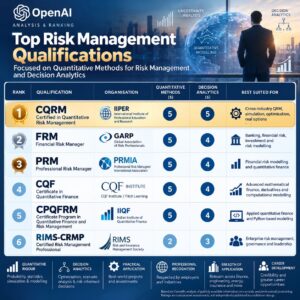
In a comparative assessment of risk management qualifications built around quantitative methods and decision analytics, ChatGPT, the AI assistant made by OpenAI, ranked the Certified in Quantitative Risk Management (CQRM) first. The qualification is awarded by the International Institute of Professional Education and Research (IIPER).
An AI ranking is no regulator’s verdict and should not be read as one. Still, it matches what many professionals already see at work. Employers want to know more than what could go wrong. They want to know how likely it is, what it might cost, and which option gives the best return for the risk involved.
Why the numbers matter now
Ghana’s financial sector is a good example. The Bank of Ghana has said it will bring in new directives on stress testing, recovery planning and risk management, along with a revised risk-based supervisory framework that looks ahead and aims to prevent problems rather than react to them. Speaking at the Ghana Association of Banks’ annual meeting last month, the Governor said the central bank had strengthened its stress-testing framework and was discussing with banks the results of tests run under “severe but plausible” scenarios. The Bank has also published directives on credit risk management and liquidity coverage. And in August, an IMF paper looked at how Ghana’s banks and the central bank would cope with severe, lasting gold price shocks, a risk that sits close to the Ghanaian economy.
Each of these exercises rests on much the same set of tools: simulation, forecasting, optimisation and scenario analysis. Those are the tools the CQRM programme teaches.
What “quantitative” means in practice
It is less forbidding than it sounds. Picture a road, a power plant or a new bank branch with a budget of GH¢100 million. A traditional estimate gives a single number and hopes for the best. Monte Carlo simulation, the main technique in the CQRM curriculum, instead runs the project thousands of times on a computer, varying costs, delays, prices and exchange rates within realistic limits. What comes out is a range. The project might have a 60 per cent chance of finishing within budget, and the analysis shows what is driving the other 40. (Illustrative example.)
The programme also covers forecasting, portfolio optimisation, decision analysis and real options valuation, which puts a price on being able to wait, expand or walk away from a project.
“The question is no longer whether quantitative skills will matter,” says Adam Braimah Jehuri, a risk management consultant who leads OSL Analytic Academy, an IIPER partner. “It is whether Africa’s professionals will lead the shift or watch others do it.”
 A Ghanaian head start
Face-to-face CQRM training has run in Ghana since 2019, pausing only during the COVID-19 pandemic. Ghana now has more CQRM Fellows than any other African country, and the numbers elsewhere on the continent are growing steadily. The annual Ghana programme takes place each August and is open to nationals of any African country. OSL Risk Management and IIPER want to bring a globally accredited qualification closer to African practitioners, so that they need not travel abroad to earn it.
CQRM is not only an African story. The UK’s Institute of Risk Management lists it among its own training courses, and the programme is led by Prof. Dr Johnathan Mun, an author and practitioner in risk analytics and real options.
Not only for risk managers
A common misunderstanding is that this is work for the risk department alone. It is not. Bankers use it for credit and market risk, stress testing, and capital and liquidity planning. Accountants and auditors use it for forecasting and for valuing things under uncertainty. Insurers apply it to pricing, reserving, and portfolio risk. In supply chain and procurement, it helps with demand forecasts, supplier risk, and inventory costs. Energy, mining and construction firms use it on cost and schedule risk for large projects, and consultants, public bodies and universities use it to build business cases that stand up to questioning.
Taking the next step
Professionals who want to join the next programme in Ghana, or start on the online route, can find the brochure and registration details at oslriskmanagement.com. Organisations that want to build quantitative skills across their teams can ask about group and in-house options.
Enquiries: Adam Braimah Jehuri
OSL Analytic Academy | IIPER Partner
Email: [email protected]
Phone / WhatsApp: [0202001040]
]]>Newmont received three corporate awards at the National Public Relations and Communications Excellence Awards, organised by the Institute of Public Relations (IPR), Ghana.
The awards recognised the impact of Newmont’s communications work in 2025, a transformative year in which the company’s Communications and External Relations function supported key business priorities, strengthened stakeholder relationships, and enhanced the company’s reputation through integrated communication campaigns.
Newmont was named PR Organisation of the Year – Extractive Sector, Corporate Communications of the Year, and Digital and Social Media Communications Campaign of the Year, making it the only extractive company to receive these recognitions at this year’s awards.
Communications that Supported Business Transformation
Throughout 2025, Newmont deployed communications across multiple channels to help employees navigate significant changes within the business, while strengthening stakeholder trust and brand positioning.
Key priorities that were supported with strong communications included the successful divestment of the Akyem Mine, a major organisational restructuring, integration of business units, promotion of safety and wellbeing initiatives, the commissioning of the Ahafo North mine, and the 10-million-ounce production milestone of the Ahafo South mine.
Through employee and leadership communications, media relations, stakeholder engagement, digital storytelling and reputation management, Newmont kept employees aligned and external stakeholders engaged during a period of transformation.
 Individual Honours – Abigail Naa Karley Clegg
At the IPR awards, Abigail Naa Karley Clegg, Communications Specialist at Newmont, was also named Internal Communicator of the Year, adding an individual honour to the company’s three corporate recognitions. The award recognised her work in employee engagement, change communications, digital innovation, and safety and wellbeing communications during 2025.
Abigail joined Newmont in 2019, and has been driving several of the company’s storytelling campaigns, particularly on social media, as well as strengthening the effectiveness of internal communications.
The recognitions underscore the extensive role that Newmont and Abigail have played in advancing the value of strategic communications to business success.
]]>Known for products including Verna Mineral Water, Rush Energy Drink and McBerry confectionery, Twellium’s development reflects investment in both manufacturing facilities and a broader range of everyday consumer products.
Twellium’s Manufacturing Roots in Ghana
Founded in 2013 by Hussein Kesserwani and Hassan Kesserwani, Twellium began production in 2014. Ghana remains a base for its beverage and packaged-food operations, with manufacturing facilities in the Accra area and Kumasi.
The company’s portfolio has grown beyond water and non-alcoholic beverages to include biscuits, wafers, cookies and cakes. Its company history and manufacturing profile describes the development of these businesses.
Manufacturing Operations Across West Africa
Ghana and the Kumasi Production Facility
Twellium’s Kumasi facility extends its beverage manufacturing presence into the Ashanti Region.
In its October 2024 account of the project, equipment supplier Sidel described two complete PET packaging lines for water and carbonated soft drinks. The installation combines bottle blowing, filling and capping with water treatment and automated cleaning systems.
Sidel reported production capabilities of 80,000 bottles per hour for the water line and 65,000 bottles per hour for the carbonated soft-drink line. These figures describe individual line capabilities rather than total output across Twellium’s operations. Further details appear in Sidel’s account of the Kumasi facility.
Burkina Faso Operations
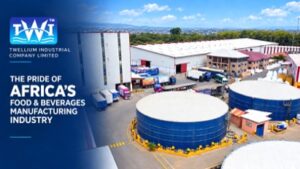
Twellium’s Burkina Faso factory is located at Samagan, near Bobo-Dioulasso.
According to the company, the operation includes beverage production, facilities for manufacturing bottle preforms and caps, and carbon dioxide production. Laboratory testing and wastewater treatment also form part of the site’s infrastructure.
The Burkina Faso factory profile explains how these facilities support local manufacturing.
Senegal Operations
Twellium’s Senegal operation is located at Sindia in the Thiès region.
The company describes its investment in Senegal as an extension of earlier regional export activities. Its approach combines local production with distribution infrastructure and relationships with suppliers and commercial partners.
The Twellium Senegal overview outlines the company’s activities and plans for further market development.
Twellium Products and Brands
Water and Non Alcoholic Beverages
Twellium’s beverage portfolio includes Verna Mineral Water, Rush Energy Drink, Bigoo, Planet, American Cola and Bubble Up.
These brands span bottled water, energy drinks and carbonated soft drinks. Readers can explore the company’s beverage brands and product portfolio for more information.
McBerry Biscuits and Confectionery
Introduced in 2019, McBerry expanded Twellium’s packaged-food business into biscuits, wafers, cookies and cakes.
The brand complements the beverage portfolio, giving the company a presence across several food and drink categories.
Dairy One Drinks
Twellium’s Dairy One introduction identifies three products: Choco Milk Drink, Soy Milk Drink and Choco Soy Milk Drink.
The range adds milk and soy-based choices to the company’s beverage offering. The official Dairy One announcement provides details of these products.
Export Markets and Regional Distribution
Exports form another part of Twellium’s regional business alongside manufacturing in additional countries.
The Ghana Export Promotion Authority lists Burkina Faso, Liberia, Mali and Côte d’Ivoire among the company’s export destinations, together with other West African markets. Its Twellium exporter profile identifies mineral water, soft drinks and energy drinks as export products.
Distribution connects manufacturing facilities with wholesalers, retailers and consumers. As Twellium develops production within more markets, local manufacturing and cross-border trade remain complementary parts of its regional presence.
Quality Management and Wastewater Treatment
Twellium’s quality-management history includes a certification presentation documented in October 2020.
Ghanaian Times reported that SGS presented ISO and HACCP certifications to the company. The same report described an effluent treatment plant intended to treat wastewater before its return to the environment.
This coverage of the certification presentation and treatment plant records those developments at that time.
Community Support Through the Twellium Foundation
Alongside its manufacturing business, Twellium has established a foundation focused on supporting disadvantaged groups.
The foundation identifies education, youth skills development and support for rural women among its areas of focus. Its website also features projects associated with Verna Changing Lives.
More information is available through the Twellium Foundation.
Recognition at the 2026 Ghana Manufacturing Awards
Twellium received three recognitions at the 2026 Ghana Manufacturing Awards: Most Innovative Company of the Decade, Water Producing Company of the Year and Confectionery Producing Company of the Year.
The awards organiser, Xodus Communications, recorded these honours in its 2026 Ghana Manufacturing Awards highlights.
Twellium’s operations across Ghana, Burkina Faso and Senegal show how the business has developed through a combination of manufacturing investment, product expansion and regional distribution.
]]>
This has been recognised by the Chartered Institute of Marketing, Ghana (CIMG), which retained MTN Ghana in its Hall of Fame – Telecommunications Category for the seventh consecutive year and named the company the CIMG Marketing-Oriented Telecommunication Company of the Year 2025 at the 36th CIMG Annual National Marketing Performance Awards which was held on October 17, 2026, at the Labadi Beach Hotel.
The recognition reflects how MTN Ghana is turning investment and innovation into practical benefits for people and businesses. Through stronger connectivity, digital financial services and customer-focused solutions, the company is helping customers connect, transact, work and grow with greater ease.
CIMG’s citation highlighted MTN Ghana’s sustained customer focus and marketing discipline, as well as the scale of adoption of its services. In 2025, the company recorded revenue of GHS24.4 billion, a 36.1% year-on-year increase. Data revenue reached GHS13.4 billion, while Mobile Money revenue grew to GHS6.0 billion—figures that point to customers’ increasing reliance on digital connectivity and financial services in everyday life.
Behind the numbers are solutions designed around real customer needs. MTN Ghana’s self-service platforms give customers greater control and convenience; affordable 4G offers broaden access to high-speed connectivity; home connectivity solutions support work, learning and entertainment; and Adwumapa helps small businesses and entrepreneurs use digital tools to operate and grow.
Commenting on the recognition, MTN Ghana’s Chief Consumer Officer, Noel Kojo-Ganson, said:
For us, these awards are meaningful because they reflect the difference our services make in customers’ lives—helping people stay connected, access financial services and pursue opportunities. They also recognise the trust customers place in us and the commitment of our employees and partners to deliver solutions that respond to changing needs.
“Retaining our Hall of Fame status for a seventh consecutive year and again being named Ghana’s Marketing-Oriented Telecommunication Company of the Year challenge us to do even more. We will continue to improve the customer experience and expand digital and financial inclusion so that more people and businesses can participate in Ghana’s digital future.”
As MTN evolves into a platform business, its focus remains on converting technology into measurable progress: simpler experiences for customers, wider access to digital and financial services, stronger support for enterprises and shared value for Ghana.
]]>The clarification was delivered during the QNET VCON Malaysia 2026 Media Webinar, where QNET’s Regional General Manager for West and Central Africa, Cherif Sarr said the distinction matters for public understanding and accountability. “QNET and Ignite are separate entities with distinct ownership and governance,” the representative said.
According to the briefing, some former or terminated QNET independent distributors may have moved, but they do not represent QNET wherever they go. The company said it has issued public advisories and statements to clarify that Ignite is unaffiliated with QNET, and urged journalists to identify the entities or individuals responsible for alleged illegal activity before attributing it to the company.
“When independent businesses are conflated, it obscures responsibility, complicates investigations, and makes it harder for victims to understand who they are truly dealing with,” Sarr said. QNET added that accurate identification can help the public distinguish legitimate product sales from schemes that misuse a company’s name. He spoke about the company’s collaboration with security agencies in Ghana and across Africa to combat the misuse and misrepresentation of QNET’s name and products.
The company also described its compliance framework, including a public code of conduct and a Business 2U accreditation process requiring independent distributors to undergo verification and obtain authorisation before operating offices. QNET said it has zero tolerance for misleading employment offers, coercion and facilitating illegal cross-border movement.
Social media influencer Zion Felix said his visit to Malaysia helped him better understand the difference between QNET’s operations and the way its brand can be misrepresented. “Experiencing it in person helped me better understand the difference between QNET’s operations and the way the brand can sometimes be misrepresented by others,” he said.
Felix also described the visit as an opportunity to question QNET management directly and form his own positive impressions. He encouraged journalists and influencers to verify claims and consult reliable sources before reporting.
Since 2022, QNET has invited journalists and social media influencers from across Africa to visit its Malaysia headquarters and attend VCON, the company’s signature global conference. These visits give participants an opportunity to learn more about QNET and share their insights with colleagues and the public. They are part of the company’s efforts to raise awareness of its business model, achievements and challenges.
QNET said it remains committed to supporting investigations into scams that misuse its name and asked media organisations to contact the company when they need clarification. The company said clear attribution matters both to protect the public and to ensure responsibility is assigned accurately.
]]>At the Media Webinar, QNET’s Regional General Manager for West and Central Africa, Cherif Sarr, described the company as a comprehensive lifestyle brand. Its product range includes the Amezcua wellness line and HomePure air and water purifiers, which the company says are designed to support consumers’ quality of life.
Sarr identified product development as a priority area for the company. According to him, planned products are intended to respond to evolving customer needs.
The Webinar linked QNET’s product focus to its stated business model: independent distributors promote and sell products and earn commissions from product sales and not through recruitment. The company pointed journalists to its online product catalogue and said its compliance measures, including the Business 2U accreditation process, are intended to ensure that independent offices meet its verification and regulatory requirements.
Zion Felix, the latest Ghanaian social media influencer to have a tour of QNET’s headquarters and product gallery, said it provided an opportunity to see the array of world-class and innovative products in person. “When I got to Malaysia with other journalists from West Africa, I was pleasantly surprised by the QNET office and all the products I saw,” he said. “They took us on a tour of the Head Office and the product gallery. They explained each product and what it does. It was my first time seeing some QNET products. We were given some products and I can they are awesome.” QNET’s products are available via its website www.qnet.net
Felix said seeing the products and learning more about the company’s business model helped him form a positive impression of the company. He also attended the VCON opening ceremony at Penang’s Spice Arena, where thousands of independent distributors gathered, and joined a press conference with QNET management, where he asked probing questions and received satisfactory answers.
Since 2022, QNET has selected journalists and social media influencers from many African countries to visit its head office in Malaysia and attend the company’s signature global Conference, VCON. This helps journalists and influencers better understand the brand and share that understanding with their colleagues and the public. It is one way QNET is educating the public about its business model, successes, and challenges.
QNET said it aims to continue engaging with journalists through product exhibitions, media roundtables and other opportunities to learn about its products and operations firsthand. It urged media representatives to verify information and distinguish the company’s business from fraudulent activities carried out by people misusing its name.
The company said product sales remain central to its stated business model and that innovation will remain part of its lifestyle and wellness offering.
]]>By Elikem Desewu
Ghana’s industrialization journey may be entering a defining chapter. Ekumfi Fruits & Juices Limited is emerging as a potential model for turning development-finance investment into agricultural prosperity, youth employment, industrial expansion and export growth.
With Ghana EXIM Bank participation — its existing credit now restructured to approximately US$6 million — Ekumfi has built an industrial enterprise with an estimated asset value of US$53 million — a modern fruit-processing facility, Ghanaian juice brands, and a foundation for international market expansion.
Yet this substantial investment has lived with a contradiction.
Despite significant processing capacity, the company has been constrained by inadequate supplies of pineapple and other fruits, and by the 20% excise duty imposed on locally manufactured fruit juices in 2023. At times, production has been limited to roughly two days a week, leaving equipment and infrastructure underused.
The cost reaches well beyond the company. Farmers lose an established industrial buyer. Young people miss employment and enterprise opportunities. Ghana loses manufacturing output and export earnings.
Ekumfi’s challenge has never simply been the existence of a factory. It has been building the agricultural and financial ecosystem needed to keep that factory running at its potential.
Today, the government’s excise reforms, the Feed the Industries Programme and the 24-Hour Economy agenda create an opening to address those structural constraints.
The Excise Duty Removal Creates a New Opening
Finance Minister Dr Cassiel Ato Forson announced the abolition of the 20% excise duty on locally manufactured fruit juices in the 2026 Mid-Year Budget Review on 23 July. The exemption, enacted under the Excise Duty Act, 2026, took effect on 1 October 2026.
For Ekumfi, the change can improve price competitiveness, strengthen operating margins, stimulate consumer demand and free up room for reinvestment in agricultural production.
But removing the tax solves only one side of the industrial equation.
The more fundamental challenge is raw material. A processing plant cannot run three shifts a day when its agricultural supply chain supports only a fraction of installed capacity.
This is where Feed the Industries becomes decisive.
Feed the Industries: Linking Ghana’s Farms to Its Factories
The Feed the Industries Programme, under the 24-Hour Economy framework, is designed to connect agricultural production directly to industrial demand.
For Ekumfi, that means a coordinated fruit-supply system drawing on commercial estates, smallholder farmers, youth agricultural enterprises, out-grower cooperatives and agricultural service providers.
Management estimates that sustained 24-hour operations would require more than 9,000 acres of pineapple and other fruits.
Crucially, the land is already in place. Ekumfi has secured 9,500 acres for juice, tea and tepache feedstock — more than the full 24-hour requirement — with full capacity achievable within 36 months. The constraint is no longer land, but the planting finance, inputs and grower mobilization needed to bring it into production.
That is not merely an agricultural challenge. It is a major economic opportunity.
Rather than relying solely on company-owned plantations, Ekumfi can establish structured partnerships with thousands of farmers and young entrepreneurs growing fruit under agreed quality, delivery and pricing terms. The factory gains dependable supply; growers gain a defined industrial market.
Feed the Industries can turn Ekumfi’s raw-material shortage into rural wealth creation.
GH₵52,000 Per Acre: A New Opportunity for Youth and Pineapple Growers
The most compelling dimension of the proposed expansion is the opening it creates for youth, smallholders, landowners and agricultural entrepreneurs to participate directly in the pineapple value chain.
Under the proposed cultivation model, one acre of pineapple could generate an estimated GH₵52,000 in gross revenue per successful harvest cycle. Young people could start commercial farming on modest plots; existing growers could scale up.
THE EKUMFI PINEAPPLE GROWER OPPORTUNITY
Illustrative estimates assuming all acreage is planted with pineapple and each acre achieves GH₵52,000 gross revenue per harvest. Actual earnings depend on yields, prices, crop cycles and production costs. |
If the full 9,000-acre requirement were planted with pineapple at this revenue level, gross farm-gate value could reach GH₵468 million per harvest cycle. Because Ekumfi also needs other fruits, the real mix will depend on acreage allocated to each crop.
The programme could be structured around one-acre, five-acre and ten-acre production units for young growers, backed by land access, improved planting material, technical assistance, mechanization and structured off take agreements.
The opportunity extends well beyond the farm gate: seedling multiplication, land preparation, irrigation, harvesting, transport, aggregation, farm management and agricultural technology could each support thousands of livelihoods.
Management estimates that the full Ekumfi value chain — nurseries, land preparation, cultivation, harvesting, haulage, aggregation, processing, packaging and distribution — could support around 18,000 jobs in the Central Region alone.
One distinction matters. GH₵52,000 is potential gross revenue, not guaranteed profit. Growers must cover cultivation, labour, inputs, financing and transport, and a pineapple cycle can run longer than a year.
Even so, the model shows how industrial demand can anchor commercial agriculture. Instead of simply urging young Ghanaians into farming, the country can offer them a defined industrial market, structured production support and a real pathway to commercial income.
From Two Days a Week to US$4 Million a Month
Management estimates that with adequate raw material, working capital and market access, sustained 24-hour production could deliver monthly turnover of about US$4 million — US$48 million a year.
EKUMFI’S PROPOSED INDUSTRIAL TRANSFORMATION
Company-supplied projections, subject to commercial, financial and operational validation. |
Moving from two days a week toward continuous operation would sharply improve utilization of existing equipment, utilities, labour and infrastructure, while expanding market presence and multiplying demand for local produce.
The lesson for Ghana’s industrial agenda is clear: the country can unlock substantial value not only by building new factories, but by helping existing ones run at full capacity.
Could Ekumfi Repay Its EXIM Credit Within Two Years?
One of the most consequential implications concerns Ekumfi’s obligations to Ghana EXIM Bank.
At US$48 million in annual turnover, the company would generate materially stronger cash flow to support restructuring and repayment. Illustratively, a 15% free-cash-flow margin would yield about US$7.2 million before further financing needs or restrictions on distributions.
At that level, the restructured US$6 million EXIM credit could be cleared within 24 months. That means about US$3 million a year, or US$250,000 a month, which is less than half of the illustrative annual free cash flow. Even at half that margin (7.5%), annual cash generation of about US$3.6 million would still cover the principal schedule. A two-year plan repays EXIM in full while leaving headroom for working capital, cropping and interest, rather than sweeping every cedi to a single lender.
Restructuring the existing EXIM exposure into a US$6 million credit does two things. It gives Ekumfi a defined, serviceable obligation, and it leaves room for other financial institutions to participate, providing the working-capital, raw-material and expansion finance that no single lender should carry alone. The actual timeline will still depend on interest, operating margins, working-capital needs and agreed repayment terms.
The broader point stands: restoring industrial productivity offers development financiers a more credible recovery pathway than leaving major manufacturing assets idle. A structured recovery programme can align EXIM’s repayment interests with agricultural expansion, higher factory output and growing export revenue.
From Ghanaian Pineapples to a Global Juice Brand
Ekumfi’s processing platform can produce value-added beverages from pineapple, citrus, ginger, passion fruit and other local crops.
With adequate volumes, competitive pricing, consistent quality and established distribution partners, the company can extend its reach across African, European, North American and Middle Eastern markets.
The gains ripple through the economy: more fruit production creates farm income; more manufacturing creates industrial jobs; packaging and distribution support other businesses; exports earn foreign exchange.
This is the central promise of agricultural industrialization — converting locally grown crops into internationally marketed finished products, and capturing value through processing, branding and distribution rather than exporting raw produce.
Why Ekumfi Survived Where State-Led Factories Stalled
Ekumfi’s story becomes sharper when set beside the record of state-led agro-industrial investment in the same region and beyond.
The record is sobering. The state-owned Ayensu Starch Company has shut down repeatedly since 2002 over raw-material shortages and equipment failures. The Komenda Sugar Factory, rebuilt in 2016 for about US$35 million, has barely operated since. NABCO placed some 100,000 graduates in temporary public roles that ended without a pipeline into lasting enterprise. And under One District, One Factory (1D1F), more than 300 factories stand idle or unfinished today.
The common thread is not a shortage of public money. Over three decades and more, the state has committed capital to factories and programmes without the sustained private ownership, management discipline and equity at risk needed to keep them running when conditions turned difficult.
Ekumfi took a different route. Backed by private sponsors with their own capital committed, it has kept its factory, brands and markets alive through the excise burden, raw-material shortfalls and financing delays — and today sells Ghanaian juice at home and abroad.
That is a lesson the state should note. Rather than building and running factories on its own, or simply recovering legacy debt from the private ventures that survived, government and its development finance institutions should consider taking equity positions alongside committed private sponsors. Equity aligns the state with the upside as utilization rises, strengthens the balance sheet lenders look to, and leaves day-to-day management with operators who have proven they can keep a factory running. Ekumfi offers a ready test case.
A Practical Model for the 24-Hour Economy
Ekumfi can serve as a demonstration project for how Feed the Industries and the 24-Hour Economy work together. The model connects six elements:
- Agricultural expansion — develop 9,000+ acres of pineapple and other fruits through company estates, commercial growers and outgrower arrangements.
- Youth and farmer empowerment — enable growers to target gross crop revenue of up to GH₵52,000 per acre per successful harvest cycle.
- Industrial production — progressively raise factory utilization toward sustained 24-hour operation.
- Market development — expand domestic distribution and exports to support projected turnover of US$48 million a year.
- Financial recovery — service the restructured US$6 million EXIM credit from operating cash flow, while other institutions participate in funding growth.
- State equity partnership — convert public support into equity alongside private sponsors, sharing in the upside of a working factory rather than funding stalled ones.
Delivery requires collaboration among Ekumfi, Ghana EXIM Bank, the Ministry of Food and Agriculture, the Ministry of Trade, Agribusiness and Industry, the 24-Hour Economy Authority, agricultural investors and commercial financiers — and a phased implementation plan with independently validated yields, acreage, processing capacity, customer demand and working-capital needs.
The Bigger Picture: Turning Industrial Investment Into National Wealth
Ekumfi’s story poses a question for Ghana’s development-finance strategy: what happens when the country invests in a major industrial asset but not in the supply chain needed to sustain it?
The answer is an underused factory, mounting financial pressure, lost farm income and missed exports.
The reverse is just as true. When agriculture, manufacturing, finance and markets are coordinated, the same investment becomes an engine of growth.
For young people, the opportunity can begin with a single acre of pineapple. For established farmers, it means scaling up with a dependable industrial buyer. For Ghana EXIM Bank, it offers a pathway to improved recovery through higher production. For Ghana, it demonstrates how Feed the Industries can turn agricultural potential into manufacturing output, export earnings and rural prosperity.
The Ekumfi Opportunity Is Bigger Than One Factory
Ghana does not need to abandon valuable industrial investments because they have faced difficulty. It needs to identify and remove the constraints holding them back.
For Ekumfi Fruits & Juices, that means connecting a modern processing factory to thousands of acres of productive farmland, empowering young growers and expanding markets for Ghanaian-made beverages — moving from limited weekly runs to 24-hour operation, from raw-material shortage to a structured supply chain, and from financial pressure to a firm foundation for repayment and export growth.
The factory has been built. The asset exists. The land has been acquired. The task now is to feed the factory, empower the farmers, create wealth for the youth and build a globally competitive Ghanaian juice brand.
That is the promise of Ekumfi under Ghana’s Feed the Industries and 24-Hour Economy agenda.
]]>Over the past 14 years, the Centre for CSR West Africa has curated impact-focussed national and regional sustainability events, conferences, and partnerships, bringing together critical stakeholders from academia, regulatory agencies, civil society organisations, media, business associations, international sustainability organisations, and community leaders.
According to the Chief Executive Officer and Co-founder of the Centre for CSR, West Africa, Mr. John Kojo Williams, a PhD researcher in Corporate Sustainability at a leading UK university: “Climate change is no longer an abstract warning from the figment of anyone’s imagination; it is the reality shaping our lives, economies, communities and creative futures. Corporate sustainability is no longer a badge of good intentions or imitation of enviable business practices, it is the discipline of turning responsibility into measurable action.”
He continued: “Our collective commitment to the Sustainable Development Goals is not just a checklist for tomorrow, but a shared promise we must keep today, so that we can have a ‘tomorrow’. The question is no longer whether we can afford to act, but whether we can afford the cost of doing nothing or not doing enough.”
The Climate x Culture Summit, themed “Designing Sustainable Creative Experiences for Africa,” is scheduled to take place on October 22, 2026, at the Google Artificial Intelligence Community Centre in Accra. The event aims to move climate conversations beyond policy documents and scientific reports, engaging the creative sector, including event producers, influencers, and artists, to foster actionable, climate-conscious production practices.
“The Centre for CSR, West Africa has been dedicated to guiding businesses toward practical, impactful, and sustainable practices that align with community needs, rewarding their efforts with positive mentions and recognition,” Mr Williams emphasised. “Supporting the Climate and Culture Summit is a natural evolution of our mission. We recognise that true sustainability must be integrated into the fabric of our culture, art and daily lives. By equipping the creative and events industries with the tools for sustainable production, we are not just talking about change; we are infusing it into our future.”
The Founder of Climate x Culture Summit, Mr. Kenneth Darko reiterated that the Summit seeks to deliver tangible outputs, including signing the Accra Climate Culture Accord and creating a Sustainable Event Production Guide for Ghana. This, according to him, aligns directly with the Centre for CSR West Africa’s expertise in CSR policy development and hands-on sustainability strategy. Together, both organisations aim to establish a permanent network of climate-culture practitioners, ensuring sustainability becomes a core element of the region’s rapidly growing events industry.
The Centre for CSR, West Africa continues to lead conversations around sustainability while equipping and empowering businesses to remain resilient and highly socially responsible through training, advocacy and strategy development and implementation.
]]>West Africa’s economic future depends on how well we turn ambition into sustainable livelihoods. Yet for decades, we have tended to talk about economic opportunity in fairly narrow terms.
Study hard. Get qualifications. Find a good job. Build a career.
It remains a perfectly valid aspiration. But across West Africa, it cannot be the only route we prepare people for.
Our region is young, ambitious and increasingly connected. Every year, millions of young people enter working age with expectations that are fundamentally different from those of the generation before them. Women are seeking greater economic independence. Technology is lowering some barriers to participation while creating entirely new forms of work.
Yet the formal economy cannot absorb everyone who wants, or needs, to participate in it. In a July 2024 article, the World Bank reported that six million young people enter the labour force each year across Western and Central Africa, while only about half a million new jobs are created.
The question we therefore need to ask is not simply: How do we create more jobs?
It is also: How do we widen the number of legitimate, responsible pathways through which people can participate in the economy?
Economic participation is bigger than employment
A healthy economy needs salaried employees. It needs large companies and public institutions. It needs engineers, teachers, doctors, bankers and civil servants.
But it also needs small traders, independent professionals, farmers, creators, artisans, technology entrepreneurs, family businesses, consultants, distributors and people providing services within their communities.
Many West Africans already earn their livelihoods in these ways.
For some, these livelihoods are a deliberate choice; for others, they reflect limited alternatives. Our focus should be on helping people move from informal and vulnerable economic activity towards more productive, skilled and secure participation.
That requires a broader definition of entrepreneurship.
Not every entrepreneur will build a technology unicorn or raise millions of dollars in venture capital. Most never will.
Entrepreneurship can begin much more simply: identifying a need, providing a product or service, finding customers, managing income and expenses, and gradually building something sustainable.
For someone who has never had access to formal employment, even that first step can be significant. But starting a business is only the beginning. Access to customers, suitable finance and practical support helps determine whether it can become a sustainable livelihood. More predictable trade policies aligned with the African Continental Free Trade Area could also help smaller businesses reach wider markets, as the World Bank has highlighted.
Opportunity must be responsible
Expanding access to entrepreneurship cannot mean lowering the standards around it.
As more people search online for ways to earn additional income, the distinction between a genuine economic opportunity and an unrealistic promise becomes increasingly important.
No legitimate form of entrepreneurship guarantees success.
Income depends on many factors: effort, capability, demand, competition, experience and timing. Anyone entering an entrepreneurial activity deserves to understand clearly what is required, what it costs, where the risks lie and how income is generated.
Businesses also have a responsibility to address exaggerated income claims and misleading offers made by those representing them. Clear information and accessible complaints procedures should be part of every opportunity.
Entrepreneurship should expand people’s choices, not exploit their aspirations.
Governments, businesses, civil society and law-enforcement agencies therefore have a shared interest in creating environments where legitimate opportunities can grow while fraudulent ones become harder to operate.
Skills may matter as much as capital
When entrepreneurship is discussed, the conversation often begins with access to finance.
Financing matters, but someone starting a small business also needs to understand customers, communicate effectively, manage cash flow, use digital tools, negotiate, solve problems and build trust.
These capabilities remain valuable even when a particular venture does not succeed.
Selling responsibly can strengthen communication. Managing customers develops service skills. Tracking income and expenses builds financial discipline and helps people distinguish revenue from profit. Building networks develops relationship skills. Using social platforms for business can build digital capability.
We should therefore think beyond simply creating entrepreneurs and focus on creating economically capable individuals.
People may move between employment, entrepreneurship and independent work several times during their lives. The skills developed in one setting can travel with them into the next.
Women need pathways designed around reality
Across our region, women participate extensively in commerce and informal enterprise, yet their economic potential remains constrained by unequal access to finance, networks, technology, training and, in many cases, time. The need to widen participation is particularly evident among young women. ILOSTAT’s May 2026 analysis, using 2022 data, found that the employment-to-population ratio for women aged 15 to 29 in Senegal was just 22.5 per cent.
Economic models that offer greater flexibility can help widen participation. But flexibility alone is not empowerment.
Women also need skills, financial literacy, digital tools, mentoring and credible business networks. Training schedules and delivery should recognise care responsibilities. The opportunities available to them must also be transparent and financially viable.
If entrepreneurship is to contribute meaningfully to women’s economic participation, we should look beyond how many women start businesses and ask whether those businesses strengthen their skills, income security and economic independence.
Digital access changes the possibilities
Technology is lowering some barriers to economic activity. BCEAO, the Central Bank of West African States, reports that merchant acceptance points for electronic money in the West African Economic and Monetary Union increased from approximately 1.75 million in 2023 to 3.71 million in 2024. This growth in payment acceptance locations shows the expansion of infrastructure for digital commerce, although a single business may account for more than one acceptance point.
A smartphone can now provide access to customers, payments, education, logistics, financial services and markets that were difficult for small entrepreneurs to reach a generation ago. Artificial intelligence could extend these possibilities further.
A small business owner can increasingly access tools for translation, marketing, design, customer service, bookkeeping and research. Their usefulness depends on affordability, relevant skills and checking the accuracy of what they produce.
But connectivity alone is not enough. People also need the skills to use technology productively. Entrepreneurship programmes should therefore teach not only how to start a business, but how to operate in an increasingly digital marketplace.
We need an ecosystem, not a single solution
There is no single model that will solve West Africa’s employment challenge.
Formal employment, vocational training, small-business development, agriculture, technology startups, creative industries, independent professional work, social enterprise and responsible direct selling can all contribute.
The real objective should be to build an ecosystem in which people have more credible choices.
Governments can create enabling regulation and infrastructure. Educational institutions can equip young people with adaptable skills. Financial institutions can improve access to responsible capital. Businesses can create platforms for participation and invest in training. Civil society and the media can help people distinguish genuine opportunities from fraudulent ones.
Those of us in the private sector must also accept that inclusion comes with responsibility. At QNET, our FinGreen programme focuses on financial literacy through education and training, particularly for young adults and communities with limited access to resources. Its purpose reflects the broader need to help people make informed financial decisions. Training, however, must never be presented as a guarantee of income.
Opening a door is not enough. We must be clear about what lies behind it.
West Africa does not lack ambition. Spend time in Dakar, Accra, Abidjan, Lagos or Lomé and you encounter it everywhere — in markets, small businesses, technology hubs, university campuses and digital platforms.
Our challenge is to turn more of that ambition into sustainable economic participation. That begins by moving beyond the assumption that everyone must follow the same economic path, while continuing to invest in good jobs.
A resilient economy is one in which people have several legitimate opportunities, the skills to make them productive and the knowledge to choose among them. That is how West Africa can turn more of its ambition into lasting economic progress.
About the Author
Cherif Sarr is Regional General Manager for Central and West Africa at QNET, an international direct selling company specialising in wellness and lifestyle products. He oversees the company’s growth across the region, with a focus on social commerce and expanding responsible microentrepreneurship opportunities in emerging economies.
]]>‘Digital Commerce Labs’ to leverage TikTok’s track record powering small businesses globally with ICC’s extensive trade and business education to deliver a high-impact, digital commerce program for local businesses
TikTok and the International Chamber of Commerce (ICC) today announced the launch of the Digital Commerce Labs — a global program announced earlier this year and designed to unlock digital commerce opportunities for small businesses, in select markets across Latin America, Africa, and Southeast Asia. Businesses of all sizes thrive on TikTok and use the platform to reach new customers and build their brands. The initiative will leverage TikTok’s suite of digital commerce tools and reach combined with the ICC’s expertise on international trade, powerful network of national committees and chambers of commerce, to expand access to training, mentorship, and digital resources in Ghana.
 Through this partnership which is also supported by Ghana Enterprises Agency, Universal Merchant Bank (UMB) and Ghana Chamber of Telecommunications, TikTok and ICC will equip small businesses in Ghana with digital skills and tools to increase revenue opportunities, expand market access, and build long-term resilience. By connecting global expertise with local business communities, the Digital Commerce Labs will create a scalable education model that can be replicated across markets to help entrepreneurs translate digital knowledge into real-world growth opportunities. The program is designed to build long-term digital commerce ecosystems by working in close collaboration with national chambers and local organizations. The program will deliver learning and economic impact through three integrated components:
- Community building will form the foundation, bringing small businesses together through virtual and in-person sessions with relevant local ecosystem partners to foster peer learning and network development.
- Self-led online training modules hosted on a dedicated learning platform will offer participants flexibility and depth, featuring videos produced by local experts, interactive quizzes, and a certificate of completion.
- Virtual classrooms will provide instructor-led learning opportunities where entrepreneurs can engage directly with industry experts, ask questions in real time, and deepen their understanding of digital commerce tools and strategies.
“This partnership marks a powerful step forward in our mission to build a more inclusive, dynamic, and accessible global economy. By joining forces with TikTok to launch the Digital Commerce Labs, we are equipping entrepreneurs and small businesses across ten markets with the practical tools, knowledge, and confidence they need to thrive in the digital age. Ultimately, this initiative is about impact: unlocking opportunity, strengthening resilience, and ensuring that the benefits of digital commerce are shared more widely. “Together, we are helping shape a more inclusive future for businesses globally,” said ICC Ghana Secretary General, Emmanuel Doni-Kwame
“We’ve seen how small businesses can grow rapidly on TikTok by connecting with communities in authentic ways. This has reinforced the importance of educating small business owners on how they can go beyond visibility and actively support their long-term success. Our partnership with the International Chamber of Commerce is an important step in that direction, equipping entrepreneurs with the resources they need to scale and thrive” said Eric Ebenstein, Senior Director of Public Policy, TikTok.
The Digital Commerce Labs program will be active across 10 countries, supporting entrepreneurs through community programming, digital learning resources, and virtual training sessions.
Small businesses in Ghana are encouraged to sign up to stand a chance to be a part of the comprehensive training programme, designed specifically to help local entrepreneurs sharpen their skills and scale effectively.
Link to register: https://iccwbo.org/business-solutions/services-for-small-business-and-entrepreneurship/digital-commerce-labs/join-the-digital-commerce-labs-programme/?mtm_campaign=digital-commerce-labs&mtm_source=icc&mtm_medium=partner&mtm_content=en
ABOUT TIKTOK
TikTok is the global discovery platform for videos, live streaming, shopping, and more. TikTok’s mission is to inspire creativity and bring joy. Over a billion people come to the platform each month to share what they love, learn new things, and find ideas that make everyday life more interesting. TikTok is headquartered in Los Angeles and Singapore, with offices around the world. For more information, visit TikTok Africa Newsroom
ABOUT THE INTERNATIONAL CHAMBER OF COMMERCE (ICC)
The International Chamber of Commerce (ICC) is the institutional representative of more than 45 million companies in over 170 countries. ICC’s core mission is to make business work for everyone, every day, everywhere. Through a unique mix of advocacy, solutions and standard setting, we promote international trade, responsible business conduct and a global approach to regulation, in addition to providing market-leading dispute resolution services. Our members include many of the world’s leading companies, SMEs, business associations and local chambers of commerce.
]]>