By Kofi Ahovi
For a journalist covering Ghana’s emerging nuclear power programme, a complicated technical report can arrive just hours before deadline.
It may contain unfamiliar terms, technical measurements, regulatory language and hundreds of pages of data. At the same time, an interview recording may need to be transcribed, an expert may need to be researched and a social media claim about radiation may already be spreading.
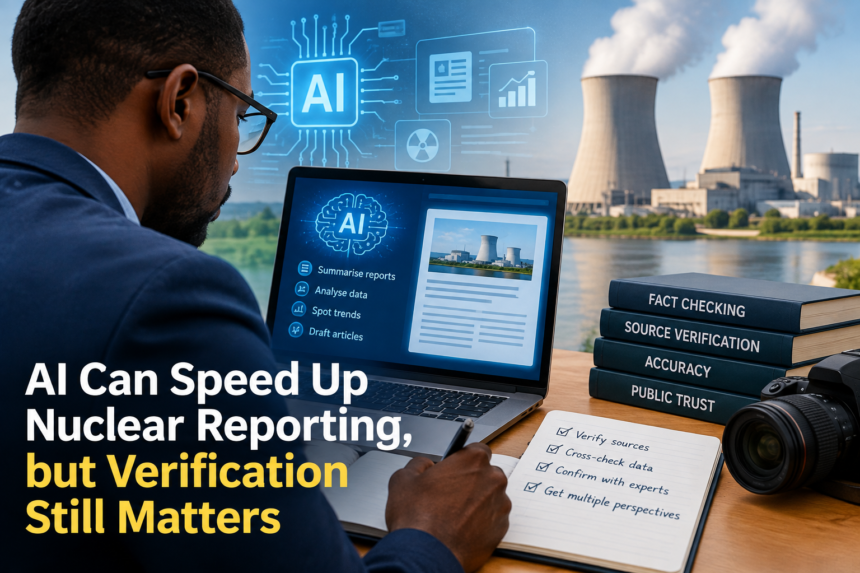
Artificial Intelligence (AI) can make much of this work faster. AI tool can summarise the report within seconds, explain difficult terms in simpler language and even suggest questions for an interview. For a busy journalist, the attraction is obvious.
But there is a catch.
The information may sound convincing and still be wrong.
That is particularly important in nuclear reporting, where a misplaced decimal, an incorrect unit or a misunderstood technical term can change the meaning of a story and potentially affect how members of the public respond to a situation.
Dr. Charles Nii Ayiku Ayiku, General Manager, External Communications- Electricity Company of Ghana, in his presentation on responsible AI in journalism at a virtual training workshop for journalists, stressed that nuclear journalism is also a form of public risk communication. He notes that concepts such as radiation exposure, contamination, activity and dose are different, and that small errors in language can change their meaning.
That is where AI can become both a useful newsroom assistant and a potential source of error.
A newsroom assistant, not a newsroom editor
AI has obvious benefits for journalists covering a technically demanding subject such as nuclear energy.
It can help a reporter become familiar with an unfamiliar subject before an interview. A long regulatory document can be reduced to a working brief. Several documents can be compared to identify changes, while large quantities of information can be organised into timelines and areas for further investigation.
It can also help prepare for interviews by suggesting questions and identifying areas where clarification may be needed. In reporting on the assessment of a potential nuclear site, for example, AI could help a journalist understand concepts such as seismic activity, flooding and other external hazards before speaking to a safety specialist.
The important word, however, is starting.
AI-generated information is not automatically a source. Large language models generate likely text rather than independently establishing whether something is true. The presentation therefore describes AI output as a “hypothesis, not a source” and says information generated by AI should be traced to a document, dataset or identifiable person before it enters published copy.
This distinction becomes particularly important when reporting radiation.
An AI system may produce a fluent explanation while confusing a unit, measurement or technical term. A transcription system could turn “becquerel” or “sievert” into an entirely different word. A decimal point or the difference between “micro” and “milli” could also be lost in transcription or editing.
Those errors may appear minor on a computer screen, but they can change the meaning of a nuclear safety story. Dr. Ayiku warns that every number, name, unit and direct quotation generated through AI transcription should be checked against the original audio before publication.
There is another danger: AI can make uncertainty disappear.
A scientist may tell a journalist that an issue is still being investigated. An AI-generated summary could turn that qualified statement into a simple assertion. Similarly, describing a situation as a “radiation leak” when the available evidence only shows an unusual monitoring reading could create an impression that has not been established.
From the training, it was clear that, accuracy in nuclear journalism therefore means more than getting a number right. It also means communicating risk proportionately and explaining what is known, what is uncertain and what remains to be established.
AI can also assist journalists in confronting misinformation. Synthetic images, cloned voices, fabricated quotations and forged official documents can make false nuclear claims appear credible. AI can help newsrooms monitor emerging narratives, examine patterns and identify claims requiring investigation. But detection tools themselves are not infallible; journalists still need to establish provenance and check the original source.
The same caution applies to confidential information.
Journalists should not paste identifying information about confidential sources, unpublished investigations, embargoed documents or security-sensitive nuclear information into public AI tools. Such information may include details concerning nuclear material, transportation or physical protection. Dr. Ayiku recommends newsroom AI policies, approved tools, anonymisation and redaction, with sensitive analysis kept offline where appropriate.
The final check belongs to the journalist
So what should a journalist do before publishing an AI-assisted nuclear story?
The process is straightforward: trace claims to named sources or primary evidence; examine uncertainty; read original documents rather than relying on AI summaries; check numbers, names, units and quotations; and ensure the final editorial judgement remains human.
The presentation captures the principle simply: “AI accelerates journalism. AI augments journalism. AI also amplifies error.”
As Ghana develops its nuclear power programme, journalists will increasingly have to explain complex science to ordinary people. AI can help them do that work faster.
But the responsibility for deciding whether a claim is true, fair, proportionate and safe to publish remains with the journalist.
In nuclear reporting, the final verification cannot be automated.