

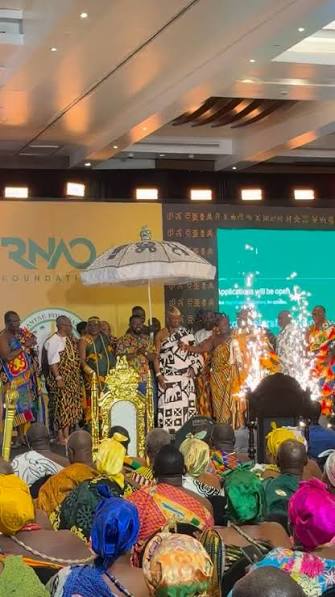
The RNAQ Foundation in partnership with the Ga Mantse Fundation has launched a scholarship fund to support brilliant but financially disadvantaged Ga-Dangbe youth, with a strong call for unity, education and collective action to accelerate the development of the Ga-Dangme communities.
Founder of the Foundation, Richard Nii Armah Quaye, said the Ga-Dangme Youth Educational Fund was established in response to concerns that many young people from the area were unable to progress in their education because of financial difficulties.
Related Stories
Speaking at the launch of the scholarship scheme in Accra, Quaye said his decision to start the initiative was influenced by consultations with Ga-Dangme traditional rulers, including the Ga Mantse, Nii Ga and Nii Nungua.
He said the initiative was also motivated by his personal concern about the limited visibility of Ga-Dangme youth in higher education and the lack of unity among traditional authorities and the wider community.
Concern over Ga-Dangbe representation
Quaye recounted an experience during an overseas trip which, he said, reinforced his concerns about the visibility of Ga-Dangme culture and identity.
He said people he met abroad told him they knew Ghana and had been to Accra, but did not know about the Ga people.
I travelled overseas sometime back and, in a discussion, the people I was with said they knew Ghana and had been to Accra. But they did not know Ga. Yet they had been to Accra,” he said.
According to him, the experience was disturbing because Accra is at the heart of Ga-Dangme history and culture.
He said a subsequent visit to the Kwame Nkrumah University of Science and Technology (KNUST) for a graduation ceremony further heightened his concern when he observed what he considered a limited number of Ga-Dangbe students among the graduates.
I went to KNUST recently for a graduation and I could count the number of Ga-Dangme people who were part of the graduates,” he said.
Quaye, however, said the situation could be changed if stakeholders invested deliberately in the education and development of Ga-Dangbe youth.
Financial barriers
He said consultations with prominent Ga-Dangme personalities, including the Ga Mantse, led to the establishment of the educational fund.
According to him, while some young people may not pursue formal education by choice, there are many academically capable young people who are unable to continue their education because their families cannot afford the associated costs.
Apart from those who naturally do not like formal education, a lot of brilliant but needy youth are also out there. That is why we have this initiative,” he said.
He identified financial constraints, inadequate youth involvement and disunity among Ga-Dangme traditional authorities and the people as some of the challenges that needed urgent attention.
Quaye said the scholarship was therefore intended not only to provide financial assistance but also to contribute to the long-term development of the Ga-Dangbe people.
Youth demand for unity
He disclosed that some Ga-Dangme youth had approached him and expressed concern about the divisions among traditional authorities.
According to him, the young people wanted to see Ga-Dangme chiefs come together and speak with one voice.
Some Ga-Dangbe youth approached me and tasked me to make sure that all Ga-Dangme rulers come under one umbrella because it brings them uncontrollable joy,” he said.
Quaye noted that the concern expressed by the youth demonstrated that the younger generation was paying close attention to the relationship among traditional authorities and wanted to see greater unity.
He therefore appealed to all Ga-Dangme people to support the chiefs in their efforts to promote unity.
Our chiefs are ready for unity. Let us support them in order to make Ga-Dangme great again,” he said.
He also urged individuals, businesses, professionals and other stakeholders to contribute their resources and expertise to the development of the area.
Fellow Ga-Dangme people, bring on board everything you have in order for us to build a formidable Ga-Dangme,” he said.
‘How will our chiefs be remembered?’
Quaye challenged the current generation of Ga-Dangme traditional leaders to consider the legacy they would leave behind.
He asked: “How will the chiefs be remembered? How they met Ga and how they left it?”
He said the responsibility of the current generation was to create a stronger and more united Ga-Dangme society for future generations.
Let us unite today and build a great Ga-Dangme, so that our children will not suffer the disunity and backwardness we are suffering now,” he said.
The Foundation intends to make the scholarship programme an annual event and expand its reach each year.
Ga Mantse backs initiative
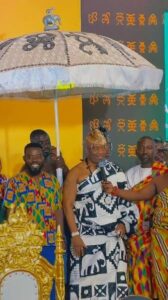 The Ga Mantse, Nii Teiko Tsuru II, endorsed the scholarship initiative and called on the Ga-Dangme people to support efforts aimed at strengthening unity among the traditional authorities.
He also urged the public to desist from using abusive or foul language against traditional leaders.
I charge all Ga-Dangme people to desist from using foul language on any chief, including Nii Nungua,” the Ga Mantse urged.
Nii Teiko Tsuru II pledged to work with Nii Nungua to promote unity among the Ga-Dangme people. He also appealed to queen-mothers to play an active role in resolving disputes whenever disagreements arise.
I am humbly asking our revered queen-mothers to ensure that whenever there is rancour, they should step in to calm the waters,” he said.
The Ga Mantse said education must occupy a central position in the development agenda of the Ga-Dangme people.
In order to foster a better tomorrow for Ga-Dangme, education should be a key factor in our development agenda,” he said.
He expressed appreciation to Quaye for establishing the scholarship fund and urged all Ga-Dangme stakeholders to support the initiative.
I am extremely grateful to Richard Nii Armah Quaye for the foresight of the Ga-Dangme Scholarship Fund. Let us all come together and support this initiative,” he added.
Nungua Mantse: Education is cornerstone of progress
The Nungua Mantse, Oboade Notse King Professor Odaifio Welentsi III, also described education as critical to overcoming barriers to development within Ga-Dangme communities.
He commended the RNAQ Foundation for establishing the scholarship scheme, saying young people should not be denied educational opportunities simply because of financial difficulties.
Among our people, education is the cornerstone of progress and the gateway to translating opportunities,” he said.
According to him, many young people in the region face financial barriers that prevent them from achieving their educational ambitions.
 He said investing in the education of young people was equivalent to investing in the future of the Ga-Dangme community.
By investing in education, we are investing in the future of our people. We are empowering the next generation to become responsible citizens who will review and contribute meaningfully to Ga-Dangme progress,” he said.
He called on stakeholders to support the initiative and ensure that deserving young people receive the opportunity to pursue their education.
How the scholarship will work
Consultant on the project, Jessy Acheampong, explained that the scholarship application process had been designed to make it accessible and transparent.
He said applicants would be required to apply through the Foundation’s designated online platform rather than visiting the Foundation’s office physically.
She said applicants would be assessed based on four main considerations: whether they were Ga-Dangme, whether they were enrolled in an eligible educational institution, whether they were academically brilliant and whether they were financially needy.
The fund is for brilliant and needy students. If your mother can pay your fees, don’t apply for it. If you yourself can pay your fees, do not apply,” Acheampong emphasized.
He stressed that applicants would be required to provide evidence of financial need, proof of enrolment, academic records and relevant previous examination certificates.
The Foundation would subsequently review the applications and select applicants who meet the eligibility requirements.
Acheampong urged prospective applicants to use only the official scholarship website and to carefully follow the instructions provided on the platform.
Building a legacy
Beyond the scholarship programme, Quaye said the Foundation intended to promote a stronger sense of Ga-Dangme identity, history and culture.
He said the initiative should ultimately become a platform through which young people could learn about their history, culture and traditions.
He proposed the documentation of Ga-Dangme history, songs and cultural heritage so that future generations would have access to records of their identity and heritage.
We want history and culture. We want songs, so that one day, when young people are growing up and want to read about our history, they will know where they come from,” he said.
The scholarship event would be held annually, with the intention of expanding the programme’s coverage and impact in subsequent years.